
AMETIS: LABELLING AT THE HEART OF INDUSTRIAL TRACEABILITY

A regulatory framework shaping industrial investment
Industrial labelling is no longer a secondary issue. It is a direct consequence of a growing body of European regulation that has become increasingly dense since the early 2000s. Regulation (EC) No 178/2002, known as the General Food Law, requires food traceability at every stage of production, processing and distribution, with each operator required to identify both its suppliers and customers. In terms of consumer information, Regulation (EU) No 1169/2011, known by the acronym INCO, sets out the mandatory information that must appear on prepacked foods: name of the food, list of ingredients, highlighted allergens, net quantity, use-by or best-before dates, storage conditions, nutrition declaration and identification of the responsible operator.
According to the DGCCRF (Directorate General for Competition Policy, Consumer Affairs and Fraud Control), failures to comply with these labelling rules regularly lead to recalls and sanctions. For manufacturers operating on tight production flows and shipping across Europe, the issue is not only legal. It becomes a matter of operational continuity: a poorly designed, illegible or non-compliant label can lead to delivery refusals, stock immobilisation and, in the event of a health incident, difficulty isolating the batches concerned.
This is precisely where the solutions developed by AMETIS come into play. The company designs, deploys and maintains labelling systems suited to a wide range of configurations, from nutritional labelling for the food industry to technical marking for aerospace, as well as regulated identification for chemicals and pharmaceuticals. Its approach is integrated: needs analysis, drafting of specifications, development of business interfaces, pilot testing, then deployment and operator training.
The sophistication of coding standards
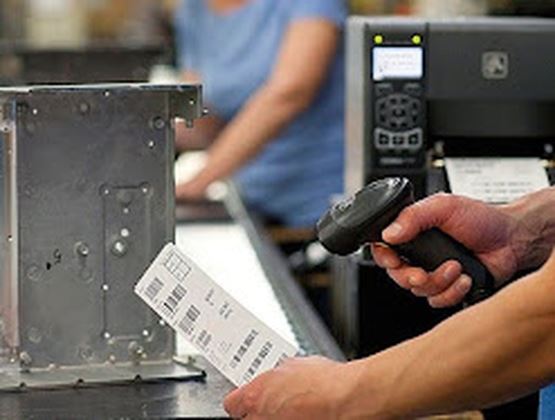
Beyond consumer information, it is the codification of logistics units that structures the movement of goods. The GS1-128 standard, formerly EAN-128, makes it possible to encode far more than a product identifier in a barcode: batch number, use-by date, quantity, and an 18-digit SSCC (Serial Shipping Container Code) used to uniquely identify each pallet or parcel. Combined with the GTIN for trade items and the GLN for locations, this standards ecosystem makes it possible to retrieve the history of a given product at any point in the chain.
The arrival of two-dimensional codes (DataMatrix, QR code) has broadened the field. A DataMatrix measuring just a few square millimetres can store several hundred characters, making it possible to include the serial number, batch, manufacturing date, origin and a unique identifier on packaging where space is limited. This capacity has become central to the serialisation of pharmaceutical products, in application of Directive 2011/62/EU on falsified medicines, but also in premium food, cosmetics and automotive parts.
AMETIS distributes the market’s leading technologies (Zebra, Toshiba Tec, CAB, Avery and Datalogic printers) and combines them with label design software (Codesoft, NiceLabel, Teklynx) capable of managing text, logos, pictograms and 1D and 2D codes, either on standalone workstations or through a centralised server connected to the ERP, production management system or CMMS. This software integration is one of the areas where system reliability is decided: the printed data must reflect the state of the information system in real time, without manual intervention that could introduce an error.
Inkjet printing and on-the-fly serialisation
Alongside self-adhesive labels, direct marking on products or primary packaging continues to gain ground. High-resolution inkjet printheads can now print text, barcodes, DataMatrix codes and logos on materials as varied as wood, metal, cardboard, glass, plastic, textile or concrete. Recent controllers can operate several printheads simultaneously, meeting the constraints of multi-product lines.
The cartridge-based technology promoted by AMETIS offers notable operational advantages: instant restart, operation without heavy maintenance, and no splashing. On sites subject to high production rates and demanding environments (IP65 housing, vibrations, dust), this robustness reduces unplanned stoppages. The available inks also cover specific use cases, from inks certified for direct food contact to inks resistant to abrasion or solvents, as well as UV inks for secure markings.
This versatility is what enables a single integrator to address sectors as varied as seeds, food processing, automotive equipment, aerospace and pharmaceuticals. AMETIS claims nearly 4,000 client companies in France equipped with machines under maintenance contracts, a fleet that reflects the gradual spread of automated industrial labelling throughout the productive economy.
Label production backed by integration expertise
The other side of the business concerns the production of the label itself. AMETIS has an ISO 9001 V2015 and Imprim'Vert-certified production unit, capable of handling custom orders, in digital printing or UV flexography with up to seven colours, on a wide range of materials. Its integrated departments (graphic design and pre-press, multi-material lamination, holographic strip, inkjet incrementation) meet demanding specifications in terms of security and anti-counterfeiting protection.
The issue here goes beyond print performance. According to a recent analysis by Global Market Insights on the industrial labels market, growth in the sector, estimated at 7.5% per year through to 2035, is being driven by a combination of factors: increased supply chain traceability requirements, the fight against counterfeit products, the expansion of e-commerce and the tightening of sector-specific regulatory frameworks. Manufacturers are increasingly integrating authentication elements, such as holograms, invisible inks and unique serialisation codes, to protect their brands in globalised markets.
An intervention chain extending to after-sales service
In an installed base comprising several thousand machines, operational availability depends as much on equipment as on after-sales service. AMETIS relies on a network of technicians located throughout France, trained by its manufacturer partners, who handle installation, training and routine maintenance for printers, labellers and integrated systems. Locally managed spare parts stock is designed to reduce downtime in the event of an incident.
This proximity-based approach responds to a simple industrial reality: a workshop operating continuously cannot tolerate several days of downtime on a marking stage. Service continuity has now become one of the key selection criteria for manufacturers when choosing an integration partner, alongside the technical performance of the equipment and the functional depth of the software.
The ALLFORPACK EMBALLAGE PARIS 2026 meeting point
ALLFORPACK EMBALLAGE PARIS brings together around one thousand exhibitors and 24,000 visitors, 75% of whom were decision-makers at the 2024 edition. The show’s offering is structured around four areas: Packaging and materials, Design and printing, Process and packaging, and Intralogistics and transport. This organisation highlights the sector’s major challenges, including line automation, industrial performance and the evolution of printed media.
For professionals looking to make their end-of-line operations more reliable or secure their logistics flows, the event is a privileged meeting point with technology suppliers and identification solution integrators. AMETIS will present its ranges of labellers, printing solutions, thermal and inkjet printers, as well as its label design software connected to industrial information systems. For visitors, it is an opportunity to compare the technological approaches available in a market that continues to become more sophisticated as regulatory and logistics requirements increase.