COBOTS AND PALLETISING: THE REVOLUTION IN END-OF-LINE OPERATIONS

Robotic palletising solutions, particularly those developed around cobots from Universal Robots, help optimise logistics flows while improving productivity, safety and flexibility on packaging lines.
Palletising, an essential link in the logistics chain
In most industrial facilities, palletising takes place at the very end of the production line. It consists of stacking packaged products – cartons, bags or parcels – onto pallets in order to facilitate their transport and storage in warehouses.
Although this operation is essential to the continuity of logistics flows, it is often associated with significant constraints. Repetitive movements, heavy lifting and variations in height make this task particularly demanding for operators.
In a context where companies must handle high production volumes and a wide diversity of product formats, manual palletising can quickly become a bottleneck for packaging line performance. Loading errors, unstable pallets or damaged packaging can also lead to logistics losses and additional costs.
It is in this context that robotic palletising solutions are rapidly developing in the packaging industry.
Cobots, a new generation of robots for end-of-line operations
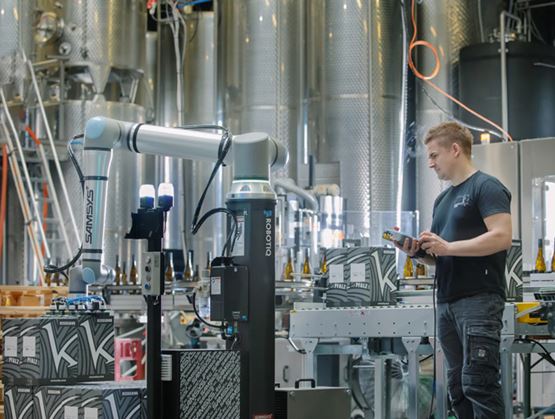
Collaborative robots, or cobots, are now among the most accessible technologies for automating end-of-line operations. Unlike traditional industrial robots, which are generally installed in isolated cells, cobots are designed to work in interaction with operators within flexible production environments.
Cobots developed by Universal Robots stand out in particular for their ease of integration and their ability to quickly adapt to production needs. They can be programmed to perform various palletising tasks and easily reconfigured when carton formats or pallet patterns change.
In packaging environments, these robots handle the manipulation and stacking of products at the end of the line with a consistent level of precision. Thanks to their repeatability, they enable the creation of homogeneous and stable pallets, reducing the risk of damage during transport.
Technical features suited to packaging lines
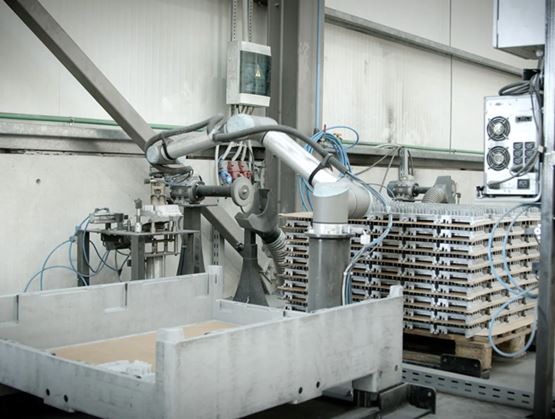
Universal Robots cobots used for palletising notably include the UR10e, UR20 and UR30 models, designed to handle loads ranging from 10 to 30 kilograms depending on the application.
The UR20 model, for example, offers a reach of 1,750 mm, allowing it to cover a wide working area and stack products at different pallet heights. This feature is particularly useful in end-of-line operations where robots must handle cartons or parcels coming directly from packaging machines.
Cobots are also equipped with integrated force and torque sensors, enabling the robot’s movements to automatically adjust based on interactions with its environment. This technology helps ensure safe operation when working in close proximity to operators.
Another major advantage lies in the simplicity of programming. Universal Robots robots use an intuitive interface that allows operators to program the robot’s movements via a touchscreen or through manual guidance. This approach significantly reduces the time required to configure or modify an application.
In a typical palletising cell, a cobot can perform several hundred cycles per hour, depending on the weight of the products and the configuration of the line. This pace allows it to keep up with high-speed packaging lines while maintaining a high level of precision in the placement of cartons on pallets.
Collaborative palletising solutions often integrate ready-to-use systems, including the robot, a gripping system adapted to the products, as well as software capable of automatically generating palletising patterns.
Addressing labour constraints and workforce shortages
Beyond productivity, palletising automation also addresses major human challenges. Palletising positions are often associated with physically demanding tasks that can lead to musculoskeletal disorders.
By automating these operations, cobots help reduce repetitive tasks and heavy lifting, improving working conditions for operators. They can then be reassigned to higher value-added activities such as supervising production lines or carrying out quality control.
This shift also responds to the labour shortages many manufacturing industries face for manual handling roles.
Concrete applications in industry
Several industrial companies have already integrated collaborative palletising solutions to modernise their packaging lines.
In the agri-food sector, CAVAC has automated the palletising of bags of dried vegetables at its new production site in order to increase production speed while reducing the physical strain of the role.
In the pharmaceutical industry, Sanofi has deployed several Universal Robots cobots at its Tours site to automate certain palletising operations within its packaging workshops.
For its part, the company Nutriset has also chosen to automate this stage in order to reduce musculoskeletal disorders linked to repetitive tasks.
These examples illustrate how collaborative robotics solutions are helping to transform end-of-line operations.
A technology at the heart of innovation showcased at ALL4PACK EMBALLAGE PARIS
As manufacturers seek to gain flexibility and efficiency, collaborative robotics solutions are emerging as a key lever for modernising packaging lines.
Cobots offer a high level of adaptability in modern production environments, where product formats and references change frequently. Their ability to be quickly reprogrammed allows companies to adapt to these changes without having to halt their installations.
For professionals gathered at ALL4PACK EMBALLAGE PARIS, robotic palletising solutions therefore illustrate the innovations that are redefining end-of-line operations and logistics chains in the packaging industry today.