
WOODEN PALLETS: A KEY DRIVER FOR OPTIMIZING LOGISTICS CHAINS

A major player in the sector in France, the Archimbaud Group has established itself as a specialist in pallet manufacturing thanks to an integrated industrial organization and recognized expertise. Through its brands Migeon and Francepal, the group offers standardized and custom-made pallets designed to meet the requirements of many industrial sectors.
Industrial production serving logistics
With nearly 7 million pallets produced each year, the Archimbaud Group occupies an important place in the French logistics ecosystem. Its industrial operations rely on several production sites located mainly in Nouvelle-Aquitaine and Maine-et-Loire, where all the elements required for pallet manufacturing are produced.
The group’s pallet production benefits from 11 high-speed nailing lines spread across several industrial workshops. These lines make it possible to produce both standardized pallets and custom pallets, while ensuring consistent quality and high production rates.
This industrial organization is supported by significant infrastructure, including 200,000 m² of storage areas, including 40,000 m² under cover, ensuring a constant availability of pallets for industrial clients.
Thanks to this logistics capacity and a network of transport partners, the Archimbaud Group can quickly respond to its customers’ needs and ensure the continuity of their industrial operations.
Full control of sawing and raw materials
One of the Archimbaud Group’s specific strengths lies in its fully integrated manufacturing process, from wood sawing to the final production of pallets.
At its industrial sites located in Deux-Sèvres and the Landes, the group operates 9 sawing lines, including 3 lines dedicated to large-diameter logs. These facilities process more than 400,000 m³ of wood each year, mainly used to manufacture the boards, beams and blocks required for pallet production.
Sawing is the group’s historical core activity. The softwood processed in these facilities is used to produce the different structural components of pallets, such as boards, beams and blocks.
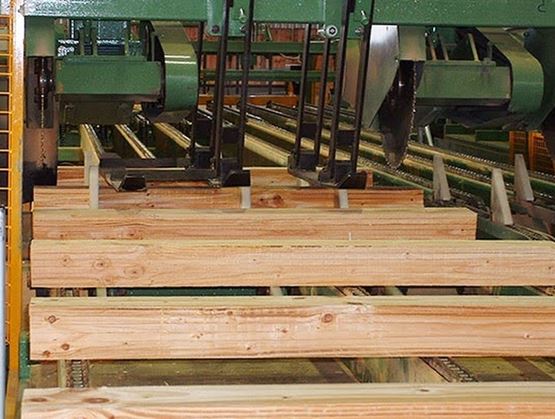
To ensure product stability and quality, the facilities also include 20 drying and ISPM 15 treatment chambers, ensuring that the pallets comply with the sanitary requirements for international transport.
The precise management of log stocks ready for sawing helps secure supply for customers, whether for one-off orders or regular requirements.
The sawing lines are designed to handle high production volumes while maintaining strong flexibility. They make it possible to produce large standardized series as well as smaller specific series, adapted to the particular needs of certain clients.
Valorizing local wood species and optimizing resources
The pallets manufactured by the Archimbaud Group are mainly produced from local wood species, such as maritime pine, Douglas fir, spruce, fir, laricio pine or poplar. This proximity between forest resources and industrial sites helps reduce the environmental impact linked to transporting raw materials.
The sawing lines dedicated to large-diameter logs also make it possible to valorize certain local species, such as poplar, which is notably used in the manufacturing of pallet beams. Part of this wood is also supplied to other industries, including furniture and construction.
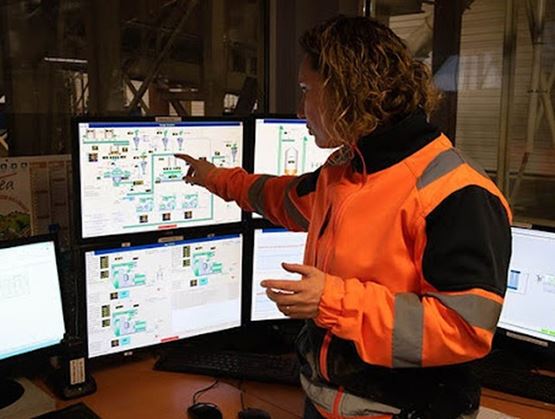
In order to optimize forest resources and improve product quality, the group also develops its own industrial tools through its internal engineering office.
The sawing lines dedicated to smaller logs, for example, make it possible to produce boards with smaller knots, offering better mechanical properties for pallet manufacturing.
A wide range of pallets for industry
Thanks to this integrated industrial organization, the Archimbaud Group offers a wide range of pallets designed for many industrial sectors, including the food industry, agriculture, chemicals, cosmetics, pharmaceuticals and automotive.
A French leader in the manufacturing of two-way stringer pallets, the group also produces four-way pallets, particularly suited to automated handling systems.
Among the most widely used standards is the EPAL Euro pallet, which is broadly used across European logistics networks. The EPAL pallets manufactured by the Archimbaud Group comply with all the requirements of this certification.
The company also manufactures specific pallets designed for certain industrial sectors.
Pallets
- CP pallets, for example, are designed for the transport of chemical products and meet high safety requirements.
- VMF pallets, notably used in the glass and wine industries, enable the safe transport of bottles.
- In the automotive industry, GALIA pallets facilitate the handling and transport of industrial components.
- IBC pallets, meanwhile, are designed for transporting containers of liquids or powders used in several industrial sectors.
- Finally, fruit pallets are specifically designed to meet the logistics standards for transporting fruits and vegetables.
Custom solutions for the supply chain
Beyond standard formats, the Archimbaud Group also develops custom pallets to meet the specific needs of logistics chains.
Technical teams analyze loading, handling and storage constraints in order to optimize pallet design and find the best balance between mechanical strength and wood consumption.
The company also operates a prototyping workshop, allowing test pre-series to be produced before launching full-scale production.
Pallets can be customized through several options, including ink or hot stamping marking, painting, or specific treatments.
The group also offers Archikit, a pallet solution delivered in kit form ready to assemble. This approach helps reduce logistics costs and optimize the transport of components.
An essential element of packaging supply chains
As production and packaging lines become increasingly automated, pallets remain a fundamental element in the organization of industrial flows.
Whether for storage, handling or transport, these supports play a key role in the smooth functioning of the supply chain.
The solutions developed by the Archimbaud Group, Migeon and Francepal illustrate the importance of these systems in the overall performance of logistics chains.
For professionals gathered at the trade show ALLFORPACK EMBALLAGE PARIS, these innovations highlight the central role of handling solutions in the evolution of the packaging and distribution industries.