
PACKAGING COMPANIES AND CONSUMER EXPECTATIONS IN 2025

The 2025 consumer study, conducted by OpinionWay for the ALLFORPACK EMBALLAGE PARIS trade show, highlights a clear shift in French consumers' expectations regarding packaging. Sustainability, clear information and price are now key factors in purchasing decisions. In this context, packaging companies are gradually adjusting their practices in order to provide concrete and consistent responses to consumer expectations.
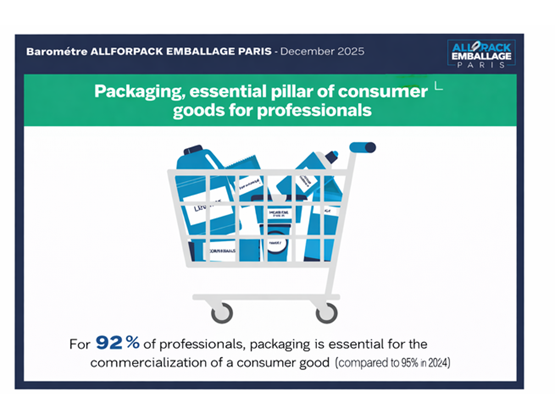
Packaging continues to play a central role for business
Although this proportion is slightly lower than last year, it confirms the fundamental role of packaging in marketing. Furthermore, 76% of respondents believe that the importance of packaging has increased over the last two years, highlighting its growing role in the relationship between products and consumers.
Recyclability and weight reduction: initial responses to sustainability expectations
To meet consumer expectations regarding environmental impact, companies are focusing on levers that can be activated immediately. Recyclability remains the number one priority: in 2025, 75% of professionals cite easy-to-recycle packaging as a priority, up from 2024.
Material weight reduction is also gaining ground, cited by 52% of respondents, while the integration of recycled materials is becoming a must for 50% of companies. These trends reflect a pragmatic response to consumer sustainability expectations, while taking industrial constraints into account.
Innovation: gradual responses to consumer expectations
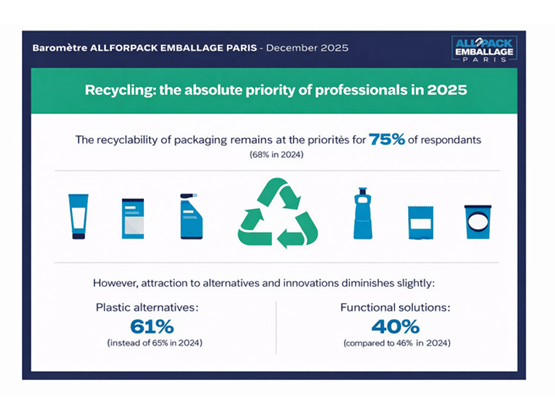
Regarding developments in plastics, 54% of respondents believe that their use should decrease in the short term thanks to the development of alternatives, while 21% anticipate an increase, linked to certain market realities. In 2025, the perceived trends are changing: the transition to recycled or bio-based plastics remains the top priority, cited by 60%, followed by the rise of reusable plastic packaging, mentioned by 38%. Fibre composites containing less plastic are cited by 33% of respondents.
These choices reflect a desire to adapt responses to consumer expectations while remaining compatible with existing practices.
Price, a key factor in the responses provided
Economic considerations play an important role in companies' responses. The price of materials remains the main factor cited, with 65% of professionals identifying it as a determining factor. Other factors are also mentioned, such as the quality of materials by 32% of respondents and the necessary investments by 26%.
In this context, companies favour gradual changes in order to meet consumers' environmental expectations while maintaining the affordability of products.
Transparency and information, a clearly identified expectation
Companies perceive a clear change in consumer expectations in terms of information. In 2025, 37% of professionals believe that consumers will primarily demand greater transparency and information on packaging. This expectation ranks ahead of the demand for reusable packaging, cited by 35%, and the desire to buy less plastic packaging, mentioned by 31%.
Other expectations are also growing, such as practicality, cited by 26% of respondents. These changes reflect a growing demand for clarity and guarantees, which companies are seeking to meet by providing better information and more consistent messaging.
A regulatory framework shaping companies' responses
The responses provided by companies are part of an increasingly structured regulatory environment. In 2025, legislation will become the primary driver of ecological choices for 55% of professionals, ahead of the environmental impact of the company, cited by 46%, and consumer expectations, mentioned by 45%.
At the same time, the image and social responsibility benefits associated with a responsible packaging strategy are growing, cited by 41% of respondents. This dynamic reflects a gradual convergence between regulatory requirements, societal expectations and corporate strategies.
A gradual response to consumer expectations
Through this survey, the ALLFORPACK EMBALLAGE PARIS trade show highlights how packaging companies are responding to the expectations expressed by consumers in 2025. By leveraging concrete levers such as recyclability, lighter materials, the integration of recycled materials, transparency of information and price considerations, players in the sector are gradually adapting their practices.
This evolution is part of a continuous transformation process, at the crossroads of environmental, economic and regulatory issues, and illustrates the sector's ability to adapt its responses in line with market expectations.
Read the full study
See also: How the French will view packaging in 2025
Meet packaging experts at the ALLFORPACK EMBALLAGE PARIS trade show from 24 to 26 November 2026 at Paris Nord Villepinte.
Image crédit : Public domain vectors - Unsplash