
PACKAGING AS SEEN BY THE PUBLIC AND PROFESSIONALS IN 2025

In a context of changing consumer habits, packaging is becoming an increasingly important factor in purchasing decisions.
The 2025 consumer study, conducted by OpinionWay for the ALLFORPACK EMBALLAGE PARIS trade show, provides a detailed overview of French consumers' expectations, trade-offs and positioning with regard to the packaging of everyday products.
Conducted in November 2025 among 1,001 consumers, this survey is part of the ALLFORPACK EMBALLAGE PARIS trade show's role as an observatory, which analyses major developments in the packaging industry each year through the prism of usage and perceptions.
Consumers pay attention to packaging when making purchasing decisions
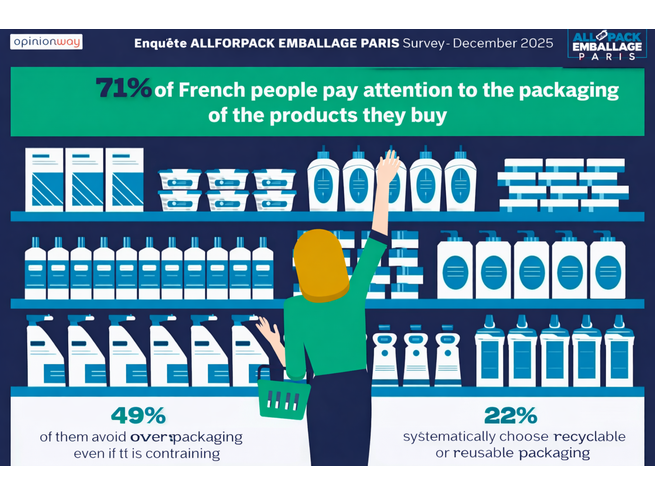
The OpinionWay study highlights a concern that is now widely shared. 71% of respondents say they pay attention to the packaging of the products they buy. This vigilance is no longer just an intention: 49% say they try to avoid over-packaged products, even when this complicates their purchases, while 22% say they only choose recyclable or reusable packaging.
Consumers do not limit themselves to a single criterion. Product information remains a priority for 42% of respondents, followed by the practicality of the packaging, cited by 37%. The sustainability of the packaging is taken into account by 32%, the place of manufacture by 33% and the material by 31%. Conversely, environmental claims remain secondary: only 16% of respondents say they pay attention to them, revealing a persistent difficulty in identifying clear and credible benchmarks.
A direct impact on consumer decisions
The results of the OpinionWay survey show that packaging directly influences consumer choices. 51% of French people say they have already bought a product because its packaging seemed more environmentally friendly. At the same time, 47% say they prefer products sold in bulk or without packaging.
Conversely, packaging can also be a factor in purchasing decisions. 34% of consumers say they have already decided not to buy a product because of its packaging. This perception is part of a broader sentiment, with 76% of French people feeling that they are too often confronted with excessive packaging when shopping. These figures reflect a growing expectation for consistency between environmental rhetoric, packaging design and perceived impact.
Marked differences between generations
The study reveals significant differences according to age. Young consumers appear to be particularly committed. 64% of 18-24 year olds say they have already purchased a product because of its packaging, which they consider to be more environmentally friendly, a proportion that rises to 70% among 25-34 year olds.
This sensitivity is also reflected in a willingness to pay more. Among those under 35, 54% say they are willing to accept a higher cost for more environmentally friendly packaging, illustrating strong expectations of brands on this issue.
Price and clarity: key factors in consumer decisions
While the desire to consume more responsibly is growing, the OpinionWay study highlights that 88% of French people cite at least one factor that limits their purchase of better-packaged products. Price is the main factor identified, with 46% believing that products with more sustainable packaging are more expensive.
Lack of clarity also weighs heavily in the decision-making process. 31% of consumers say they do not really know which packaging is the most environmentally friendly. This difficulty is compounded by marked scepticism: 83% believe that environmental claims on packaging are not always credible, and 86% find it difficult to determine whether packaging is truly environmentally friendly.
Clear expectations for the evolution of packaging
The study also shows that 81% of French people believe that packaging will have evolved within ten years. The most anticipated changes concern the development of reuse, cited by 40% of respondents, the reduction in packaging volume mentioned by 36%, and the limitation of plastic use mentioned by 39%.
Large companies and distributors identified as key players by consumers
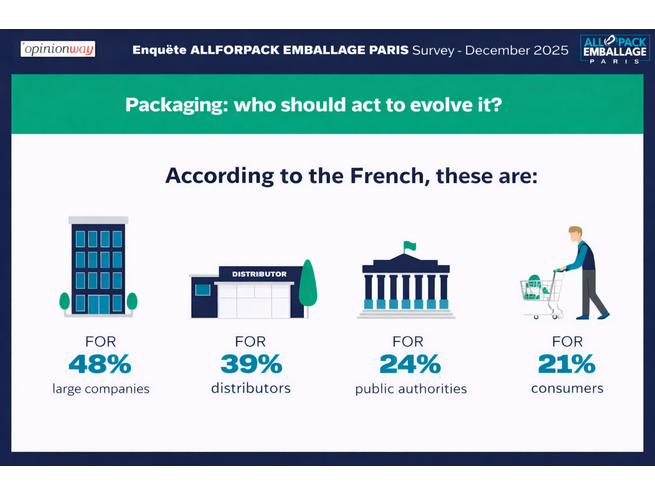
The results of the study conducted by OpinionWay for the ALLFORPACK EMBALLAGE PARIS trade show highlight explicit expectations of market players, particularly large companies and distributors. More than half of consumers, or 53%, cite companies as the players that should take priority action to reduce the environmental impact of packaging. Among them, 48% specifically mention large companies, which are perceived as having the necessary means and leverage to accelerate the transition. At the same time, 39% of those surveyed mention distributors, due to their direct role in product selection, shelf placement and formats offered at the point of sale, placing them at the heart of trade-offs between price, clarity of the offer and environmental impact.
These expectations are part of very concrete trade-offs. While 46% of French people identify price as a key factor in adopting more sustainable packaging and 31% say they lack clear information, retailers are seen as a key link in improving the clarity of offers. The prominence given to bulk or unpackaged products, preferred by 47% of consumers, also reinforces the structuring role of distributors in changing consumption practices and the choices offered in stores.
In 2025, packaging will thus become a purchasing criterion in its own right for the majority of French people, at the crossroads of price, clarity and environmental impact, with clearly expressed expectations towards market players, particularly distributors and large companies.
Read the full study
Meet packaging experts at the trade show ALLFORPACK EMBALLAGE PARIS from 24 to 26 November 2026 at Paris Nord Villepinte.
Image credit : Markus Winkler - Unsplash