
[REPLAY]: PACKAGING & ENVIRONMENTAL CLAIMS: COMMUNICATE WITHOUT GREENWASHING

On 13 November 2025, ALLFORPACK EMBALLAGE PARIS organised a webinar on the theme of ‘Packaging and environmental claims: how to communicate without resorting to greenwashing?’, a subject that has become essential at a time when brands must provide tangible proof of their commitments. Faced with a rapidly changing regulatory environment, manufacturers must now ensure that their messages are accurate and consistent.
To shed light on these issues, the exhibition welcomed Bruno Siri, General Delegate of the Conseil National de l’Emballage (CNE); Alexandre Vernier, Packaging Impact Manager at the BEL Group; and Chantal de Lamotte, Director of the ALLFORPACK EMBALLAGE PARIS trade show
Discover the last webinar!
In her introduction, Chantal de Lamotte reiterated the importance of providing the industry with reliable guidelines, given that packaging is at the heart of societal expectations and legal obligations. Companies must cope with rapid changes, both in terms of materials and environmental communication, making educational and operational support necessary.
Bruno Siri presented the role of the CNE, an organisation recognised by ADEME and the public authorities since 1997. The CNE brings together all players in the sector and publishes reference documents on good packaging practices, including a guide dedicated to environmental claimsIts committee of experts continuously analyses the claims found on store shelves in order to identify exact, ambiguous or misleading wording.
Packaging: defining an environmental claim, a strict framework to be followed
The webinar reviewed the principles that define an environmental claim: it must be substantiated, measurable, understandable and proportionate to the actual impact of the packaging. Bruno Siri detailed the legal framework governing these claims: the Green Claims Directive, the PPWR regulation (applicable from 2026), the AGEC law, the Climate and Resilience law, the 2022 decree and articles of the Consumer Code.
This legislative basis now prohibits overly general wording (‘environmentally friendly’), unverifiable claims (‘biodegradable’ outside the standardised framework) or overrated promises (‘100% recyclable’ if the criteria are not met). The CNE has also observed an increasing use of environmental logos created by brands, which may be prohibited if they are not based on a validated standard.
Based on feedback from the CNE's expert committee on environmental claims, Bruno Siri described the most common claims and the main errors encountered on store shelves. These include generalised statements, overly technical wording and logos without any supporting information. He emphasised the need to distinguish between actual recyclability and theoretical recyclability, not to confuse compostability with biodegradation, and to put each message into its industrial context.
How manufacturers ensure their messages are accurate: the example of the BEL Group
The second part of the webinar featured Alexandre Vernier, who detailed the approach taken by the BEL Group. The company relies on collaboration between its legal, marketing and R&D departments to formulate accurate and compliant messages. He presented several internal tools for verifying recyclability, calculating the presence of recycled material and establishing consistent sorting instructions for each country. Several concrete examples illustrated this approach:
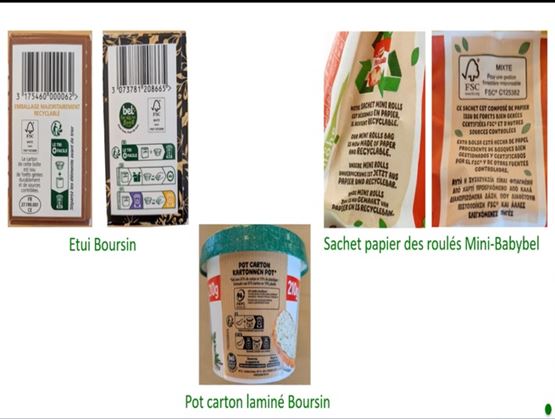
– Boursin packaging, whose claims have been reworded to accurately reflect actual recyclability;
– cardboard pots, where the residual plastic content is explicitly stated;
– Mini Babybel pouches, whose claims have been adjusted in line with regulatory changes.
These practical examples showed how manufacturers can reconcile compliance, transparency and clarity.
The session ended with a question and answer session on the method used to calculate recyclability, the management of multi-country Triman, testing in sorting centres, recycled material percentages and the adaptation of sorting instructions to different markets.
Bruno Siri and Alexandre Vernier reiterated the importance of using the official tools provided by eco-organisations, evaluating packaging as a whole, and prioritising simple and accurate communication.
This webinar confirms the trade show's commitment to supporting the industry in developing responsible, accurate and understandable environmental messages in order to promote transparent and compliant communication.
Join us from 24 to 26 November 2026 at Paris-Nord Villepinte to learn all about the regulatory, industrial and economic challenges facing the packaging industry.
Watch the replay of the webinar