
INTRALOGISTICS AND TRANSPORT: FLOWS TAKE BACK CONTROL

This pathway logic meets a specific expectation among visitors: to navigate the show by following a business theme, rather than moving through it in an undifferentiated way. This is complemented by a tailor-made visit, available through the Business+ programme, which offers support before, during and after the show, qualified business meetings and a conference agenda, the Paris Talks, structured around the themes Reinvent, Regenerate and Shine, where automation, decarbonisation and the safety of internal flows are playing an increasingly important role.
A sector at the crossroads of several urgent issues
Intralogistics is no longer limited to forklifts and conveyors. Today, it refers to all flows of goods, packaging and data within a site, from the receipt of raw materials through to the shipment of finished products to downstream transport operations. According to the expert opinion “The ecological transition of logistics”, published by ADEME in April 2025, the logistics sector, in its broadest definition, accounts for 16% of national greenhouse gas emissions, or around 63 million tonnes of CO2 equivalent per year, including 6% from storage and 7% from packaging.
This snapshot places intralogistics and transport at the heart of the industrial trade-offs of the coming years. Pressure from e-commerce on throughput, labour shortages, the need to reduce the carbon footprint of warehouses and distribution flows, and the arrival of a new European regulatory framework are converging around the same demand: faster, safer, more transparent and less energy-intensive flows. The 2025-2026 roadmap for logistics and freight transport, published by the French Directorate General for Enterprise, confirms these priorities, making logistics land, decarbonisation and modal shift three structuring priorities for the French sector.
Mobile robots, AGVs and automation: maturity is taking hold
Long perceived as a promise, the automation of internal flows has now become an industrial reality. According to data from the AGV-AMR Market report, updated in 2026, the global market for automated guided vehicles (AGVs) and autonomous mobile robots (AMRs) is estimated at $12.83 billion in 2025 and projected to reach $27.68 billion by 2034, representing a compound annual growth rate of 8.92%. By mid-2025, more than 220,000 AGV and AMR units were already operational in logistics and industrial facilities worldwide, reflecting a structural shift in warehouses towards the robotisation of flows.
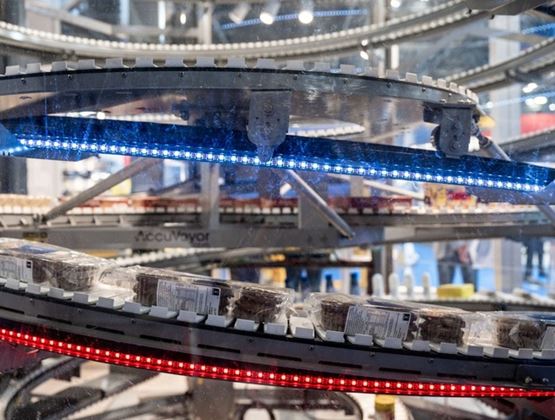
This widespread adoption is changing the nature of the pathway at the show. Visitors can see automated guided trucks for palletising, wheeled or forked AMRs for transferring bins and pallets, automated storage and retrieval systems (AS/RS), cross-belt sorters for order preparation and cobots for workstation assistance in operation. The French sector is represented through integrators and handling equipment manufacturers, alongside international players such as KION, Jungheinrich, Toyota Material Handling, Mobile Industrial Robots and Geek+, which are regularly present in the ALLFORPACK EMBALLAGE PARIS ecosystem. The logic of live demonstrations in real conditions distinguishes the show from an event strictly dedicated to lifting equipment: here, each machine is placed within a packaging, shipping and transport chain, with its interfaces with wrappers, shrink-wrappers and palletisers.
Machinery Regulation 2023/1230: the next regulatory horizon
Beyond performance, compliance is now becoming part of specifications. Regulation (EU) 2023/1230 on machinery, which replaces Directive 2006/42/EC, will apply from 20 January 2027. According to the summary published by EUR-Lex, it covers all machinery, related products and partly completed machinery placed on the European market, including forklifts, vehicle lifts, lifting accessories and now safety components whose behaviour relies on machine learning approaches.
This last point is precisely what changes the equation for AGVs, AMRs and cobots. When a safety function, such as obstacle detection, emergency braking or shared space with an operator, relies on embedded artificial intelligence, the regulation requires conformity assessment by a third-party body, rather than simple self-certification. For users, this means stronger requirements for documentation, software traceability and update management. For exhibitors on the Intralogistics & Transport pathway, it is an opportunity to present safety architectures compliant with the new framework, as well as digital instruction manuals, which are now accepted by default under the regulation.

On the energy front, intralogistics is moving forward on several fronts at once. The electrification of forklift fleets, already well advanced for machines under five tonnes, is now extending to higher power ranges thanks to lithium-ion batteries, valued for their energy density and fast charging. According to the Autonomous Mobile Robots Market analysis published by Global Market Insights, these batteries already accounted for 68.7% of the AMR fleet in 2024, reflecting a clear shift away from lead-acid technologies.
This electrification is part of a broader transformation of logistics buildings and associated transport flows. In its April 2025 expert opinion, ADEME identifies warehouse energy efficiency as one of the essential levers of a low-carbon trajectory, alongside increasing vehicle load rates, material sobriety and modal shift towards rail and inland waterways. Within the Intralogistics & Transport pathway, several exhibitors are presenting thermal management solutions, energy recovery systems from forklift braking, links between rooftop photovoltaic installations and vehicle charging stations, as well as software for optimising internal routes and downstream delivery rounds to reduce empty travel distances.
Data, the new material of the logistics chain
Behind the mechanics, a data battle is taking place. Visitors to the Intralogistics & Transport pathway will find WMS (warehouse management system), WCS (warehouse control system) and TMS (transport management system) providers that orchestrate physical flows, as well as specialists in IoT sensors, serialised Data Matrix codes and RFID labels. The challenge is to have a consolidated, real-time view of goods, whether they are in stock, being prepared, being loaded or in transit. This transparency is becoming crucial as environmental reporting obligations, driven by the CSRD for large companies, require detailed traceability of operations and their carbon footprint.
One of the strengths of the Intralogistics & Transport pathway lies in the coexistence, within the same exhibition area, of the three families of players that make up the value chain. Decision-makers from the food, cosmetics, healthcare, e-commerce and mass retail sectors can meet manufacturers of vehicles and automated systems, integrators and engineering firms, as well as software providers, transport companies and service suppliers. This configuration, combined with live demonstrations, makes the visit a focused commercial qualification environment, where contacts made along the pathway often lead to multi-year projects combining hardware, software and operational support.
The Intralogistics & Transport sector at ALLFORPACK EMBALLAGE PARIS therefore sits at the crossroads of industrial performance, decarbonisation and compliance. It offers a concrete reading of the trade-offs facing industry players over the next three years, between the robotisation of operations, the reduction of carbon footprints and adaptation to the new European regulatory framework. To explore these challenges on the ground, meet exhibitors from the pathway and attend the Paris Talks dedicated to the supply chains of tomorrow, join ALLFORPACK EMBALLAGE PARIS from 29 June to 1st July 2027 at Paris Expo Porte de Versailles.