
THE HIDDEN LOSSES OF OEE

Overall equipment effectiveness (OEE), known in France as taux de rendement synthétique (TRS), has become the common indicator in packaging workshops. In France it is defined by AFNOR standard NF E60-182, which covers performance indicators for production equipment. Internationally, ISO 22400-2 defines key performance indicators for manufacturing operations management. The principle of OEE is a simple multiplication: availability × performance × quality. Its strength is that it reduces the health of a line to a single figure. Its weakness is exactly the same, because that figure aggregates very different kinds of losses, which call for neither the same diagnosis nor the same investment. For manufacturers who exhibit at or visit ALLFORPACK EMBALLAGE PARIS, knowing where these losses lie is a prerequisite for any equipment project, especially as connected lines now make this detailed reading accessible to sites of all sizes.
Packaging line: a simple indicator, losses that are anything but
Availability measures the time the line runs compared with planned time. Performance compares actual speed with nominal speed. Quality relates good products to total output. Behind these three ratios lie the major loss categories identified by total productive maintenance approaches: breakdowns and format changeovers on the availability side, micro-stops and slowdowns on the performance side, start-up scrap and production defects on the quality side. On a packaging line, where several machines follow one another between product infeed and pallet, each category has its favourite hiding places. And the shorter, more repetitive and more ordinary the loss, the less likely it is to be recorded.
Micro-stops, the loss nobody reports
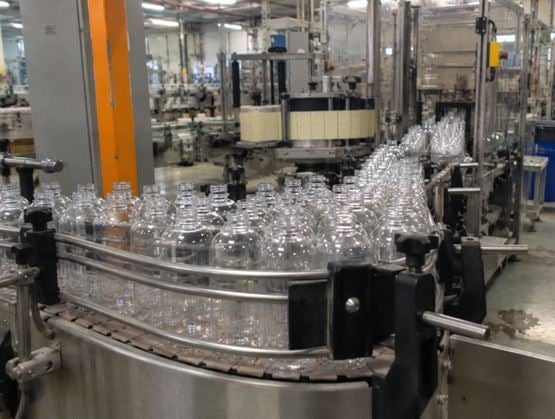
A film that slips out of position, a jam in the case erector, a sensor that detects a badly positioned carton, an operator who realigns a bottle on the conveyor. Each of these incidents lasts ten to sixty seconds and is fixed in a moment. None is logged in a production record, because none, taken on its own, seems worth reporting. Added up over a shift, however, they are among the line's main sources of loss, far more discreet than the spectacular breakdown that does trigger a report. Micro-stops are generally concentrated on one or two pieces of equipment that set the pace for the whole line, most often at the end of the line, where case formats and palletising patterns are most varied. Spotting them means instrumenting the line, because human memory only retains long stops and always underestimates how often the short ones occur.
Running below nominal speed without realising it
The second hiding place is speed loss. A line designed for 200 units per minute that runs at 170 triggers no alarm. It is producing, the lights are green, and the 15% gap dissolves over the course of the day. The causes are many. A machine slowed down to avoid jams after an incident and never returned to its set speed. Material whose properties vary from batch to batch, such as thinner films, board with different moisture content or recycled materials that behave less consistently, forcing speeds down to maintain quality. An imbalance between machines, where the slowest dictates the pace of all the others and accumulation conveyors mask the problem. These issues are growing with the changes in materials driven by the EU Packaging and Packaging Waste Regulation (PPWR), which pushes towards greater recyclability and more recycled content. A new material validated in the laboratory can cost several points of OEE on the line if it has not been qualified at real production speed.
Start-ups, changeovers and scrap: the materials bill
The third source of loss lies at the boundaries between runs. Each format changeover generates a visible stop, which shows up in availability, but also two much more discreet losses: the ramp-up after restart, when the line deliberately runs slowly, and the first products rejected while the settings stabilise. This start-up scrap consumes material, energy and time, and weighs all the more heavily as batches get shorter. In the ALLFORPACK EMBALLAGE PARIS 2025 barometer, material prices remain the main parameter cited by professionals, with 65% of respondents identifying them as a deciding factor in their choices. Every carton, metre of film or case scrapped at start-up is therefore a doubly sensitive loss, for OEE and for the operating account. Defects during steady-state production, often linked to slowly drifting settings, tool wear or material variation, complete the picture and are rarely traced back to their real cause for lack of time-stamped data.
Packaging: what OEE does not see
Some losses escape the indicator altogether. Waiting time upstream or downstream, when the line is ready but the product is not arriving or palletising is saturated, is sometimes counted as planned stoppage and sometimes forgotten. Energy consumed while idle, during stops and slowdowns, appears in none of the three ratios, even though it weighs on costs and on the site's carbon footprint. Finally, the mental load on operators who constantly compensate for the line's failings cannot be measured, but it explains some of the departures and recruitment difficulties. According to the 2026 Labour Needs survey (Besoins en main-d'œuvre) by France Travail, employers consider 43.8% of recruitment projects difficult, rising to 80.6% for machine tool operators. A line that loses OEE also loses appeal for the people who run it.
Packaging line: measuring differently to see clearly
Bringing these losses to light depends less on new equipment than on three organisational decisions. The first is to define precisely, once and for all, what counts as a planned stop, a micro-stop, a speed loss and scrap, because two teams that do not apply the same definitions produce two OEE figures that cannot be compared. The second is to capture events automatically, through machine controllers, sensors added to older equipment or a manufacturing execution system (MES), so that every stop and every speed variation is time-stamped instead of relying on manual entry. The third is to involve operators in the analysis, because they often already know which machine is holding the line back and why, and because data shared at the line changes behaviour more reliably than a monthly report. This approach is in line with the Industry 5.0 vision promoted by the European Commission, which places workers' well-being and skills, sustainability and resilience at the heart of the industry of tomorrow, beyond the pursuit of productivity alone. The production sites of tomorrow will not be those with the highest OEE, but those that know exactly what their OEE is made of.
Watching losses disappear on machines in operation
Packaging machinery manufacturers have built these issues into their equipment, with motorised adjustments and stored recipes that reduce start-up losses, vision inspection that links each defect to its cause, and open architectures that transmit performance data in real time. To assess them, nothing beats observation in real conditions.
The 2027 edition of ALLFORPACK EMBALLAGE PARIS, from Tuesday 29 June to Thursday 1 July 2027 at Paris Expo Porte de Versailles, will give greater prominence to machines in operation. Production, maintenance and continuous improvement managers will be able to watch format changeovers, ask manufacturers how their equipment reports micro-stops and speed deviations, and compare the line monitoring tools offered by integrators.