
PÖPPELMANN FAMAC: THE SPOUT GOES MONO-MATERIAL

Laundry detergent, children’s fruit purée, sauces, shower gel or pet food: the stand-up flexible pouch with a spout has become a familiar format across many retail categories. Lightweight and compact when empty, it appeals to both brands and consumers. Yet its recyclability depends on a component just a few centimetres long: the spout sealed into the pouch. This is the component at the heart of Pöppelmann FAMAC’s latest innovation, announced on 25 June 2026.
A family-owned plastics manufacturer from Lower Saxony, with a presence in France
The Pöppelmann Group appears in the show catalogue under the name PÖPPELMANN GMBH & CO. KG. It was founded in 1949 in Lohne, Lower Saxony. This family-owned plastics processing company now employs 2,500 people and serves customers in more than 90 countries from five production sites. France is part of this industrial network through Plastiques Pöppelmann France, based in Rixheim, Alsace.

The group is organised into four divisions: KAPSTO for protective elements, TEKU for professional horticulture, K-TECH for high-precision injection-moulded parts and FAMAC for packaging and healthcare. The Pöppelmann FAMAC division designs and manufactures technical components, assemblies and plastic packaging for consumer goods, the pharmaceutical industry and medical devices. Each development follows an eco-design approach, with the aim of offering resource-efficient products. For pharmaceutical and medical applications, the division also has a fully automated cleanroom.
2026 has been an eventful year for the group. Bernd Moormann joined the management team on 1 July 2026, alongside Norbert Nobbe and Christian Schwarck. Since June, Pöppelmann has also been part of the community at the IPAI artificial intelligence innovation park in Heilbronn, which brings together more than 140 members and partners.
Why does the spout matter so much for pouch recycling?
For flexible packaging to be properly sorted and recycled, all its components should ideally belong to the same plastic family. This is the principle of mono-material packaging. A polyethylene (PE) pouch fitted with a PE spout and cap therefore forms a homogeneous unit that sorting centres can direct to the appropriate recycling stream. According to Pöppelmann FAMAC, mono-PP packaging meets the requirements of mechanical recycling, with detection by near-infrared optical sorting and separation by flotation.
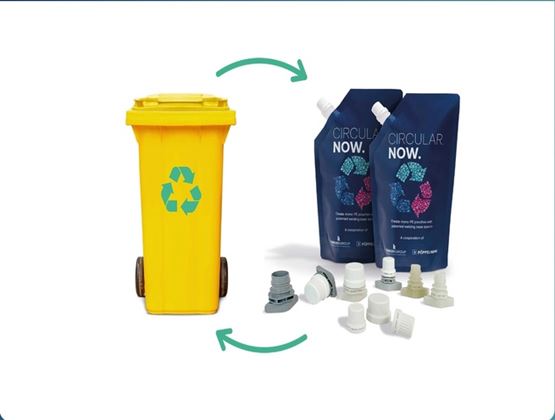
The challenge is primarily technical. When the pouch and spout are made from the same material, their melting points are very close. Sealing the spout without weakening the film therefore becomes more difficult. Pöppelmann FAMAC developed its LowSealing spouts for low-temperature sealing. This design increases the difference between the melting points of the spout and the film. It reduces the thermal stress on the pouch and ensures a stable seal. Available in PE or polypropylene (PP), these spouts are already used for food applications. They make it easier to manufacture mono-PE or mono-PP spouted pouches.
For packers, the benefits are also industrial. The spouts in the FAMAC range use a patented sealing geometry designed to protect the film. They are suitable for filling through the spout or through the pouch and are available for thermal or ultrasonic sealing. PP and PE screw caps complete the range.
A new generation of recycled-plastic spouts
The 2026 innovation targets non-food products. Pöppelmann FAMAC is launching a new generation of spouts and caps made from polyethylene derived from post-consumer recycled plastic (PCR). Their recycled content exceeds 90%. This material comes from household separate collection streams, in other words from plastic products that have already completed a full life cycle.
These spouts are initially intended for cosmetics, detergents and household cleaning products, as well as soaps and shampoos. A stand-up pouch can therefore be both recyclable and made with a high proportion of recycled material. The PCR spouts can be reliably processed on existing equipment. They are initially available in the market-standard diameter of 10.5 millimetres, with matching PCR caps.
The company already has experience with this material. In its 17.5-millimetre AE 003 cap series, switching from virgin PE to post-consumer recycled PE reduced greenhouse gas emissions by around 50%. The quality characteristics agreed with the customer remained unchanged.
Lea Middendorf, Key Account Manager in FAMAC’s Packaging Sales department, sums up the approach: “The industry is looking for solutions that meet recyclability expectations without fundamentally changing existing processes. Our PCR and LowSealing spouts show how mono-material packaging can be implemented in practice for flexible stand-up pouches.”
The PPWR sets the direction for design for recycling
This innovation fits into a precise regulatory timetable. European Regulation (EU) 2025/40 on packaging and packaging waste, known as the PPWR, has applied since 12 August 2026. Among the measures now in force, the French Directorate General of Customs and Indirect Taxes notes that all packaging must be recyclable. It also points out that 40% of plastics used in Europe are used to manufacture packaging.
Other obligations will come into force progressively, according to the same customs guidance note. These include harmonised labelling and recycled content in plastic packaging. The European Commission published a PPWR FAQ on 3 August 2026 to help companies interpret the regulation. For companies placing packaging on the market, every component must now be considered when assessing recyclability, including the spout and cap.
Pöppelmann FAMAC directly links its developments to this regulatory framework. According to the company’s announcement, mono-material solutions enable separate collection by material type and therefore higher-quality recycling. The division draws on decades of experience in material development, design and processing technologies to support its customers in meeting future requirements. For food applications, the use of post-consumer recycled material remains subject to restrictions. LowSealing spouts provide a route towards mono-material solutions in this area.
From detergents to dairy, a wide range of applications
Stand-up pouches are now replacing bottles, canisters and tubs across many categories. The page dedicated to spouts highlights pet food, detergents, personal care products and dairy products. Compared with bottles and canisters, this format reduces storage and transport costs while delivering significant material savings. For consumers, it offers easy handling, clean pouring and lower weight.
Manufacturers wishing to test these spouts on their production lines can request a free sample assortment. Beyond flexible pouches, the division applies the same approach to rigid packaging. Its non-food range includes square buckets and rectangular trays made from PCR material. Its reusable offering includes transport trays and household storage boxes.
Flexible pouches, a key topic in the Packaging & Materials sector
Recyclable flexible packaging will be a major focus at ALLFORPACK EMBALLAGE PARIS, taking place from 29 June to 1 July 2027 at Paris Expo Porte de Versailles. The Packaging & Materials sector highlights regulation, circularity and material innovation. Other exhibitors are also advancing in these areas, including AEP GROUP with its recyclable polyethylene films and AERA SA with its custom flexible packaging solutions.
For brands, packaging buyers and industrial managers, the show provides an opportunity to compare solutions, meet manufacturers and prepare for upcoming regulatory deadlines. The PPWR overview published in the show’s newsroom details the first requirements. The webinar dedicated to 12 August 2026 provides an operational roadmap.
The show’s sectors cover the entire value chain, from materials to packaging machinery. The Business Meetings service helps visitors prepare appointments with suppliers. The ALLFORPACK INNOVATIONS AWARDS 2027 will recognise the most innovative solutions in packaging, processing and intralogistics. It will be an opportunity to identify the next advances in flexible pouches.