
PACKAGING AND MATERIALS: THE INDUSTRY RETHINKS ITS MATERIALS

This pathway logic responds to a clear visitor expectation: navigating the show by following a professional theme rather than walking through it in an undifferentiated way. This approach is complemented by a tailor-made visit, accessible via the Business+ programme, which offers support before, during and after the show, qualified business meetings and a conference agenda, the Paris Talks, structured around the themes Reinvent, Regenerate and Radiate, where the question of materials plays a central role.
A pathway under regulatory pressure
For a long time, the choice of packaging material was mainly a trade-off between product protection, cost and brand image. That framework is now being disrupted. The European PPWR regulation (EU 2025/40), published in the Official Journal of the European Union on 22 January 2025 and applicable from 12 August 2026, replaces Directive 94/62/EC and now imposes quantified targets that are directly enforceable across the 27 Member States: recyclability of all packaging placed on the European market by 2030, progressive integration of recycled content in plastic packaging (between 10% and 35% depending on the category in 2030, rising to 65% by 2040), a 50% limit on empty space in e-commerce parcels and harmonisation of sorting labels.
The figures weigh heavily. According to data used by the European Commission and relayed by the CCI Paris Ile-de-France, 79.7 million tonnes of packaging waste were generated in the European Union in 2023, or around 178 kg per inhabitant. At national level, the French packaging industry represents, according to the Conseil National de l'Emballage, turnover of around €22 billion, making it one of the country’s most cross-sector industrial fields, present in food, cosmetics, luxury, pharmaceuticals, industrial goods, e-commerce, etc. The framework set by the Professional Packaging EPR scheme (EPRO), which came into force on 1 January 2026, extends these obligations to the industrial and commercial packaging segment, which had previously been less regulated than household packaging.
Paper and board: the driving force behind the materials transition
Within the pathway, paper and cardboard occupy a leading position, both in terms of volume and image. French production increased by 6.3% in 2024, reaching around 6.5 million tonnes, driven by demand from e-commerce and the food industry. The corrugated cardboard segment, structured around 11 industrial groups, 70 production sites and 15,200 direct employees, generates approximately €3.36 billion in turnover on its own. At European level, the Confederation of European Paper Industries (Cepi) estimates annual production at nearly 45 million tonnes, with a recycling rate of 82%, the highest of all packaging materials.
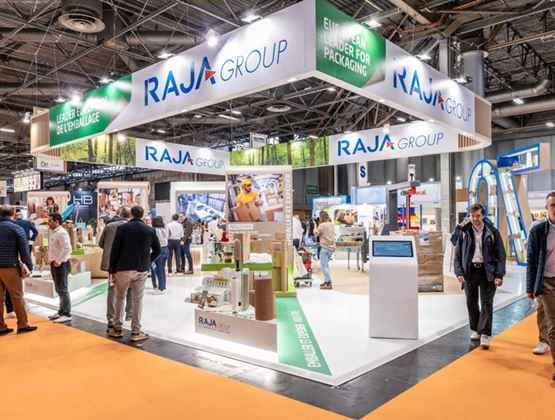
This photograph explains the buzz around the stands dedicated to paper and cardboard at the show. They include producers of papers for corrugated board, manufacturers of American-style boxes, folding boxes and grouping trays, specialists in moulded fibre cushioning as an alternative to plastic films and expanded polystyrene, as well as converters developing barrier solutions against water, oxygen or grease without using plastic laminations. The innovations presented in the showcase, transparent cellulose paper, mono-material barrier cardboard and industrially compostable trays, reflect the scale of the race to replace plastic in segments where its functionality is no longer considered essential.
Plastic, glass, metal, wood: the accepted coexistence of materials
Reducing the Packaging & Materials pathway to an opposition between plastic and fibres would, however, be inaccurate. According to Polyvia, the professional organisation for the plastics industry, plastic remains dominant in several segments where its weight-to-barrier ratio and cost remain unbeatable: liquid packaging, pharmaceutical blisters, long-shelf-life food films and technical cosmetics containers. Exhibitors now present resins incorporating recycled content (rPET, rPP, rPE), mono-material films designed to be recyclable, inorganic barriers replacing multilayer structures and chemical recycling solutions still in the process of industrialisation.
Glass, metal and wood complete the picture. Glass, long challenged by plastic in the beverage segment, is gaining ground thanks to the PPWR reuse targets (10% of beverage packaging by 2030, 25% by 2040), supported by the rollout of reusable bottle standards in several sectors. Aluminium and steel, already widely recycled at European level, play their role in cans, aerosols and certain food tins, with recycling targets raised to 70% for ferrous metals and 50% for aluminium by 2030. Wood, finally, mainly present in the pallet and crate segment, is seeing its reuse and recycling channels become more structured, while transport packaging must now reach a 40% reuse rate by 2030 under the PPWR.
Alternative materials and materials to rethink
It is probably in the alternative materials segment that the 2026 edition differs most from previous editions. The show is opening several thematic spaces dedicated to experimentation, including the Matières à Penser space, which explores the reinvention of materials and their impact on the user experience, as well as Ruptures Créatives, which gives a voice to the most daring players in packaging. These spaces host solutions based on plant fibres (straw, bagasse, miscanthus, flax), industrially compostable bioplastics, algae-based films, mycelium packaging and materials derived from chemical recycling.
This diversity is part of a European dynamic driven by the Commission’s strategy on critical raw materials and by the work of the Conseil National de l'Emballage, which calls for thinking in terms of function and life cycle rather than material in absolute terms. The design studios present at the show, packaging agencies and R&D laboratories test material choices in real conditions with buyers from mass retail, luxury, cosmetics and the food industry, in an approach that goes beyond communication and enters the realm of industrial decision-making.
From product brief to material specifications
One of the strengths of the Packaging & Materials pathway lies in the coexistence, on the same exhibition floor, of the three families of players that make up the value chain. Producers and converters of materials meet suppliers of machines, inks and surface treatments, as well as specifiers (brands, retailers, manufacturers and e-commerce operators) who define product specifications. This configuration, combined with live demonstrations and inspiration spaces, makes the show a focused commercial qualification platform, where contacts made along the pathway often lead to cross-disciplinary projects combining materials, design and packaging.
The Packaging & Materials sector at ALLFORPACK EMBALLAGE PARIS therefore sits at the crossroads of industrial performance, circularity and compliance. It offers a concrete reading of the trade-offs that market operators will face over the next three years, between European regulatory requirements, consumer expectations and decarbonisation pathways. To explore these issues on the ground, meet exhibitors from the pathway and attend the Paris Talks dedicated to the reinvention of materials, join ALLFORPACK EMBALLAGE PARIS from June 29 to July 1st 2027 at Paris Expo Porte de Versailles