
ACTIPACK: RIGID PET IN THE AGE OF THE PPWR

A regulatory milestone reshaping the PET landscape
Europe’s plastic packaging sector is going through a rare moment of change. Published in the Official Journal of the European Union on 22 January 2025 and applicable from 12 August 2026, Regulation (EU) 2025/40, known as the PPWR (Packaging and Packaging Waste Regulation), replaces a 1994 directive and introduces a common framework for all Member States. Its operational scope is considerable: mandatory recyclability at scale, harmonised labelling, restrictions on certain substances and, above all, the introduction of minimum thresholds for recycled content in plastic packaging, with a first milestone from 2028 for PET packaging.
For manufacturers of polyethylene terephthalate pots and bottles, this shift is not simply a matter of adjusting specifications. It requires them to rethink sourcing, invest in equipment compatible with recycled resins, document material traceability and, in many cases, broaden the scope of industrial applications towards products that have until now been packaged in glass or metal. This regulatory, technical and commercial equation places rigid PET manufacturers at the centre of the debate on the circular economy.
ActiPack, founded in 1992 and specialised in the production of PET pots and bottles using bi-oriented injection blow moulding, offers a concrete example of adaptation. Its management team will be present at ALLFORPACK EMBALLAGE PARIS 2026, whose next edition will take place from 24 to 26 November at the Parc des Expositions de Paris-Nord Villepinte.
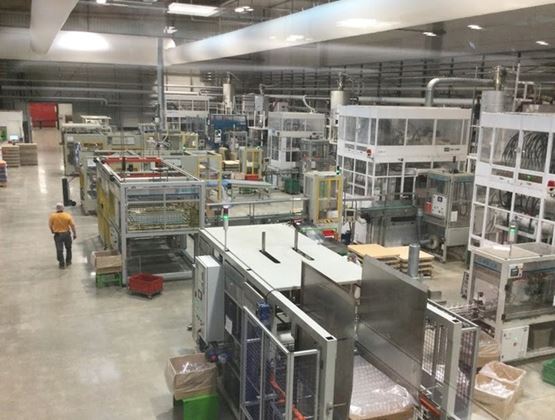
Three European sites, a continental industrial response
ActiPack’s geographic positioning reflects a logic specific to the rigid packaging sector: producing as close as possible to fillers, while limiting logistics costs and lead times for containers that are naturally bulky but low in density. The company now relies on three complementary production sites in Europe.
The original historic site is located in France, around Saint-Étienne, in synergy with Loire Plastic Industrie, a sister company specialised in plastic injection and closure solutions. Since 2001, a site in the Czech Republic (Janovice nad Úhlavou) has produced PET pots and bottles as well as HDPE bottles. Acquired in July 2016, the German site (formerly KKT GmbH) adds expertise in hot-cycle injection blow moulding, cold-cycle blow moulding, extrusion and co-extrusion. Finally, November 2023 saw the integration of Silte SRL in Italy, also positioned in PET and HDPE pots and bottles.
This structure across four industrial locations makes it possible to serve a customer base ranging from cosmetics, which according to figures provided by ActiPack represents 69% of its activity, to food, at 27%, and leisure and miscellaneous products, at 4%. It reflects a broader trend towards continental consolidation in plastics processing, where players are seeking to scale up in order to absorb investments linked to regulation and eco-design.
ISBM Hot Fill, expanding the scope of PET applications
At the heart of ActiPack’s expertise lies a precise technique: hot-cycle injection stretch blow moulding (ISBM). This technology consists of manufacturing a preform by injection, then blowing it into a mould to obtain a hollow body. The bi-orientation of the PET chains improves mechanical properties, including impact resistance and internal pressure resistance, as well as barrier performance, two essential parameters for both liquids and semi-paste products.
With a fleet of more than 44 hot-cycle injection stretch blow moulding presses and a library of more than 60 preforms covering capacities from 10 ml to 5,000 ml and neck finishes from 13 mm to 110 mm, the company has a technical matrix enabling it to address most market requirements. The “Hot Fill” range, illustrated by the 500 ml Volcano bottle designed with a standard 38 mm screw neck, is a recent example.
Hot filling consists of filling containers at a temperature of between 85 °C and 95 °C, making it possible to neutralise a significant proportion of the microbial load without using preservatives or strictly aseptic conditions. Historically reserved for glass, this process is becoming compatible with PET thanks to dedicated tooling and specific bottle geometries. Targeted applications include jams, sauces, fruit juices, iced teas, isotonic drinks and certain plant-based dairy products. For a PET processor, the challenge is twofold: to enter segments previously dominated by glass, which is heavier and more energy-intensive to transport, and to offer an alternative to metal in certain portable formats.
From RPET to weight reduction: a journey in eco-design
The opening up of PET to hot filling goes hand in hand with another underlying trend: the growing incorporation of recycled material. According to the report published in 2025 by Plastics Recyclers Europe, a federation representing more than 200 plastic recycling companies across the continent, growth in installed capacity slowed sharply in 2023, amid competition from virgin resins and low-cost imports. On the demand side, analyses published by the specialist media outlet Packaging Europe on the state of the PET market in 2025 confirm that PET consumption for bottles continues to rise, but that European RPET capacity is struggling to keep pace with the thresholds targeted by the PPWR.
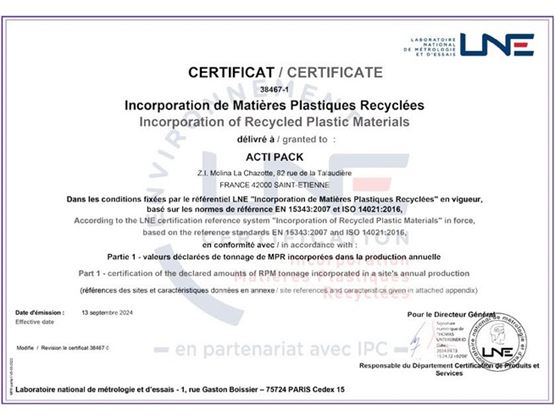
ActiPack offers its products with different proportions of RPET: 25%, 30%, 50% or 100% recycled PET material, depending on application constraints and minimum order quantities. The RPET material used is certified for food contact, an essential requirement for serving the food and liquid grocery markets. In July 2025, the company renewed its LNE MRP “Incorporation of Recycled Plastic Materials” certification, parts 1 and 2, a scheme managed by the Laboratoire national de métrologie et d'essais, which audits the flows of recycled material integrated into production.
Beyond RPET, eco-design also involves lightweighting packaging. ActiPack’s R&D department claims material reduction solutions of up to 20%. This approach aligns with one of the PPWR’s structural objectives, which encourages limits on oversized packaging and non-functional empty space in packaging placed on the European market.
In 2025, the company obtained the EcoVadis bronze medal and a B score in the SME Climate 2024 assessment by the Carbon Disclosure Project (CDP). Its Saint-Étienne site is aligned with Decree No. 2021-461 of 16 April 2021 on the prevention of losses of industrial plastic pellets into the environment, adopted under the AGEC law.
An industry player to meet at ALLFORPACK EMBALLAGE PARIS 2027
The 2027 edition of ALLFORPACK EMBALLAGE PARIS is set to be a convergence point for packaging and intralogistics players. Nearly 850 exhibitors and brands are expected, with a target attendance of around 24,000 professionals. The show has been restructured around four sectors: Packaging and materials, Design and printing, Process and packaging, and Intralogistics and transport. It will also feature a new space called Re-generation, dedicated to reusable, recyclable and compostable uses.
The Paris Talks, a conference programme launched for this edition, will address new regulations, anticipation of environmental constraints and the adaptation of business models. For a manufacturer such as ActiPack, whose offer is based precisely on the combination of bi-oriented injection blow moulding, food-contact certified RPET and Hot Fill processes, this programme provides a relevant setting for discussions with fillers, design offices and brands reviewing their ranges ahead of 2028.
ActiPack’s trajectory does not only tell the story of a plastics processing SME. At the scale of a regional group that has become European, it illustrates how the rigid PET sector is dealing with a tight regulatory timetable, still constrained recycled raw material supply, and customer markets such as cosmetics and food, which are themselves shaped by their own sustainability commitments.