
AUTOMATION IS A GAME-CHANGER

A strategic link underestimated for too long
In a factory, attention naturally focuses upstream: production lines, primary packaging, quality control. End-of-line operations, by contrast, tend to remain in the shadows. Yet it is precisely there, between the end of production and the shipping dock, that a decisive part of logistics performance is determined. Pallet wrapping, strapping, labelling, traceability: every poorly calibrated operation can lead to delays, product losses or transport disputes.
This observation is shared across the industry. The global end-of-line packaging machinery market was valued at $5.92 billion in 2024 and is expected to grow at an annual rate of 6.5% to reach $10.24 billion by 2033. Verified Market Reports This acceleration reflects a growing awareness: end-of-line is no longer a secondary cost centre, but a source of value creation. Manufacturers that automate these stages are seeing measurable gains in throughput, consistency and shipping security.
When labour shortages force companies to rethink processes
One of the strongest drivers of this transformation is structural: labour shortages. Between 2023 and 2025, many companies still viewed automation as a way to offset temporary recruitment difficulties. In 2026, that mindset has changed: labour shortages in the packaging and logistics sectors are now seen as structural rather than cyclical. Weldmaster
In France, the situation is just as strained. The share of hires considered difficult is around 57.4% in 2026, and the issue is concentrated in skilled trades and technical roles exposed to technological disruption. Parlons Business The transport and logistics sector is among the hardest hit, with sustained demand for drivers, plant operators and maintenance technicians. As a result, manual pallet wrapping positions, which are physically demanding and repetitive, struggle to attract candidates. Automation is no longer a technological luxury; it is becoming an operational response to a growing challenge in job attractiveness.
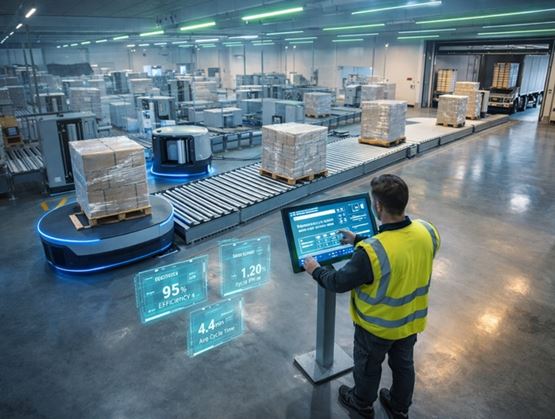
International data confirms this trend. According to a 2025 report by the PMMI (The Association for Packaging and Processing Technologies), gaps in operator onboarding and the transfer of undocumented know-how are disrupting factory performance, prompting manufacturers to invest in embedded machine interfaces, predictive maintenance and targeted automation of loading operations.
The PPWR regulation, a regulatory accelerator
Beyond labour challenges, European regulation is adding a layer of complexity that is driving automation. Regulation (EU) 2025/40 on packaging and packaging waste was published in the Official Journal of the European Union on 22 January 2025. Ministry of the Economy Known as PPWR (Packaging and Packaging Waste Regulation), this text marks a turning point: it replaces the 1994 directive with a regulation that applies directly in all Member States, with an entry into force set for 12 August 2026.
Behind its stated environmental objective, the PPWR raises very concrete questions for packaging manufacturers, packers and brand owners. Graphiline Reuse targets for transport packaging (40% by 2030, 70% by 2040), recyclability requirements, and bans on certain substances in food packaging: companies will need to adapt their packaging and palletising lines to meet these new constraints. Traceability of packaging materials, including stretch film used in wrapping, will become a key issue. Machines capable of measuring and optimising film consumption, managing pre-stretching and documenting packaging parameters will offer a decisive advantage.
The packaging machinery market is accelerating
The context is favourable. The global packaging machinery market exceeded $50.5 billion in 2025 and is expected to grow at a compound annual rate of 5.9% between 2026 and 2035. Global Market Insights The automation segment accounts for the largest share of this market, with revenues of $21.6 billion in 2025. Food and beverage remains the leading sector, but growth is also strong in pharmaceuticals, chemicals and consumer goods.
The Ministry of the Economy highlights a key point: 98% of the French agri-food sector is made up of SMEs, making modernisation both urgent and necessarily gradual. France Industrie This is precisely where recent innovations are reshaping the landscape: automation solutions are no longer reserved for large groups. Accessible, modular and compact technologies now enable mid-sized companies and industrial SMEs to automate their end-of-line operations without disproportionate investment.
Atlanta Stretch, a case study in accessible innovation
The Italian company Atlanta Stretch SpA, founded in 2004 in Poggio Torriana (Rimini) by Angelo Forni, perfectly illustrates this democratisation of automation. Specialising in the design and manufacture of automatic and semi-automatic stretch wrappers, it operates from a 12,000 m² production site, exports to more than 100 countries and relies on a network of subsidiaries in France and Spain.
Its flagship innovation, the patented ARYA system launched in 2022, marked a turning point in the sector. The principle is strikingly simple: a jet of air attaches the stretch film to the pallet automatically, without manual intervention and without compressed air or mechanical parts subject to wear. The film hooking operation, one of the most physically demanding tasks on an end-of-line, is therefore eliminated. Claimed gain: 25 seconds saved per pallet. Compatible with several models in the range (Mytho S, Neos, Lybra S), the ARYA system effectively transforms a semi-automatic wrapper into a near-automatic machine, for a limited additional cost.
From ARYA to MIRA: when the robot becomes autonomous
Atlanta Stretch took a further step in 2025 with the launch of MIRA, a multi-station autonomous wrapping robot. Equipped with a sophisticated navigation system, MIRA moves independently from one pallet to another within the facility, performs wrapping cycles continuously and creates what the manufacturer calls an "endless" packaging process. The robot integrates the ARYA system for a fully automated cycle, along with advanced safety features: a blue light arc to signal its operating area, emergency stop and obstacle detection.
The ambition is clear: to offer the highest level of automation ever achieved by a mobile wrapping robot, while maintaining the flexibility required in multi-product production environments. MIRA is designed for manufacturers handling large volumes of heterogeneous pallets in facilities where installing a fixed wrapping machine would be restrictive.
At the same time, the group created Atlanta Robotics, a division dedicated to advanced industrial automation, which made its debut in 2025 at Drinktec with SIPARIO, a new robotic concept for beverage production lines.
What SMEs need to remember
The example of Atlanta Stretch highlights a fundamental trend: end-of-line automation is no longer limited to heavy investments reserved for multinationals. Three factors are converging to make these solutions accessible to a wider audience.
The first is modularity. Systems such as ARYA can be installed on existing machines without requiring a complete overhaul of the line. The second is ergonomics: by eliminating repetitive tasks and physically demanding postures, automation helps address recruitment challenges and absenteeism. The third is return on investment. Payback periods vary, but many operations report a return within 12 to 24 months, depending on production volumes. Weldmaster
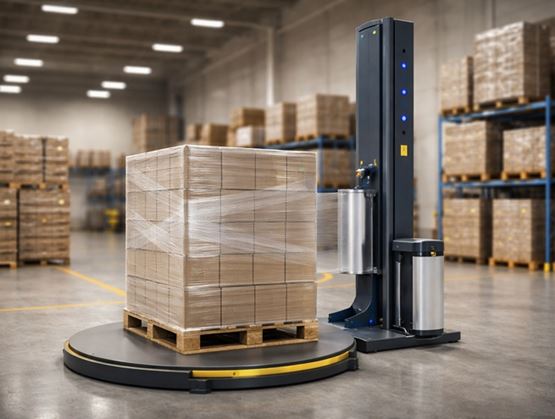
For French industrial SMEs, the question is no longer whether to automate end-of-line operations, but how and at what pace. The approach recommended by industry observers is to identify a pilot scope (a line or a product family), define three key indicators (quality, throughput, energy consumption) and roll out implementation in stages. France Industrie
ALLFORPACK EMBALLAGE PARIS 2026, a showcase for end-of-line solutions
This is precisely the kind of approach that the ALLFORPACK EMBALLAGE PARIS trade show will explore from 24 to 26 November 2026 at Paris Nord Villepinte. The 2026 edition will bring together 1,000 exhibitors and brands around a shared ambition: exploring the future of packaging in all its forms. ALLFORPACK The event covers the entire value chain, from processing to packaging, from printing to intralogistics, with 600 machines in operation.
Atlanta Stretch, already present at previous editions (the ARYA system was notably previewed there in 2022), is among the exhibitors embodying this dynamic of end-of-line innovation. Visitors will be able to discover the latest developments in the range, compare wrapping technologies and assess in practical terms the potential gains for their own production setup.
In a context where the PPWR is coming into force, labour is becoming scarcer and productivity requirements are increasing, ALLFORPACK EMBALLAGE PARIS 2026 stands out as a must-attend event for manufacturers looking to turn their end-of-line operations into a competitive advantage.