
WHAT KIND OF PLASTIC FOR THE FUTURE?

Webinar 11
ALLFORPACK EMBALLAGE PARIS gathered three speakers with complementary expertise for this webinar: Vincent Collard, Director of Recyclability and Resources at Citeo, Agnès Jacquot, Director of CSR and Communication at Sources Alma (Cristalline brand), and Arnaud Revel, Director of Operations at USEO, an industrial player specializing in the production of sustainable packaging.
Plastic Packaging: 2 Million Tons, 30% Recycling
Before discussing the strategies, Vincent Collard presented the numbers. In France, household plastic packaging represents 1.2 million tons placed on the market each year, a figure that rises to 2 million tons when including industrial and commercial packaging. The recycling rate of plastic stands at around 30%, according to data from Citeo, a level that is improving but still far behind other materials like glass (85%) or steel (100%). About 1 in 2 packages placed on the market is plastic. This imbalance between volume and actual recycling is the starting point for all the discussions in the webinar.
The good news, however, as pointed out by the speaker from Citeo: 96% of packaging materials are already recyclable by design. For plastic alone, however, we are at 75%. There are still 25 points to gain, in a short time frame and on a massive scale. This is exactly where the challenges of the coming years lie.
AGEC, PPWR: Two Texts and an Overall Logic for the Packaging Industry
The French law AGEC (Anti-Waste for a Circular Economy) has structured the national framework around three axes: reduction, reuse, and recycling. It also, as Agnès Jacquot reminded us, triggered a period of experimentation marked by the temptation to systematically substitute plastic with cardboard. A process that finds its limits when examining the real environmental balances of materials.
The EU Regulation 2025/40, known as PPWR, published in the Official Journal of the European Union in January 2025 and effective from August 2026, aims to rationalize this landscape. Unlike the directive it replaces, it is a regulation with direct application in all member states, without national transposition. Its main effect is to end regulatory fragmentation: until now, each country had developed its own legislation, creating contradictory obligations for manufacturers operating on a European scale.
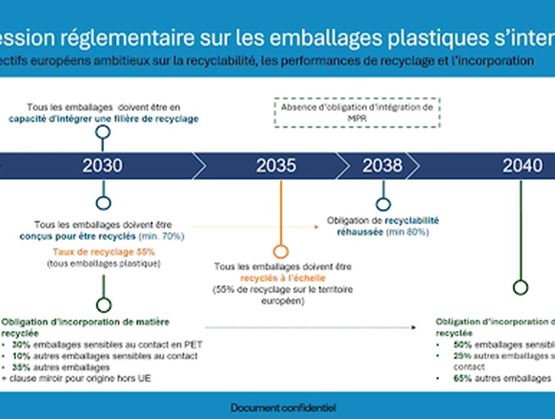
Substantively, PPWR introduces a multi-level circularity logic. Packaging will be classified A, B, or C based on their actual recyclability rate, and this classification will determine eco-contributions. For PET beverage containers, classified A and considered the best students, the goals are particularly demanding: 30% recycled content by 2030, then 65% in 2040. More broadly, all packaging must be recyclable by 2030 and recycled at a good rate by 2040.
One point that caught the participants' attention: from 2030, PPWR will end the period of experimentation with mixed cardboard-plastic packaging. Manufacturers will have to choose. Either a cardboard without any plastic barrier, which implies having solved technical issues with barriers to water, grease, and gas, or 100% recyclable plastic. Multi-material plastic-aluminum assemblies, in particular, will be banned. For companies that have not yet started this compliance work, the new industrial packaging requirements impose action without delay.
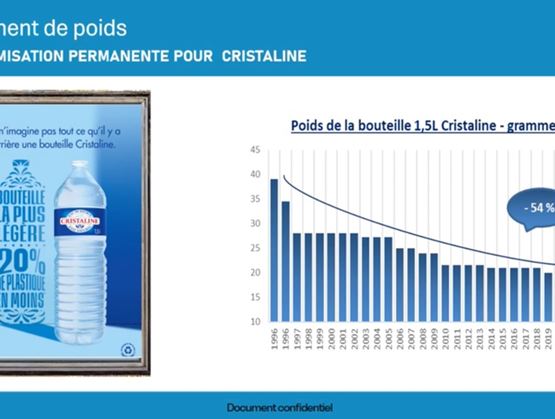
Circularity by example: Cristalline's PET bottle
Agnès Jacquot shared a concrete testimony during the webinar on what circularity means in an integrated industrial approach. Sources Alma has been recycling PET since 2009, with the first plant in Lequin (North), to which two other sites have been added (Saint-Yorre in Allier, and Charleroi). The logic: to produce the necessary RPET for bottle production in-house, made from collected bottles, to guarantee a thermomechanical recycling process suitable for food contact and enabling bottle-to-bottle return.
Choosing the Right Plastic Packaging for the Right Use: The USEO Approach
Arnaud Revel approached the issue from a different angle: that of a packaging manufacturer who chose to start with the use before choosing the material. USEO developed a range of reusable packaging for fast food, now deployed in over 2,500 restaurants in France. The implementation of washable and reusable tableware in restaurants, made mandatory in 2023, marked the starting point of a value chain analysis that took several years.
The result led to distinct material choices based on usage. For glasses, Tritan (copolyester) was chosen: resistance to washing at over 90°C, maintained transparency, shock resistance, and no transfer. These criteria were imposed by the market itself: tests have scientifically established that a transparent glass improves the sensory perception of taste for the consumer. For salad bowls and french fry containers, polypropylene (PP) was deemed suitable: less direct contact with the mouth, good washing performance, and possible integration into mass recycling systems at the end of life.
What comes out of this approach: there is no single, generalizable solution. Price, industrial speeds, hygienic constraints, and product rotation guide choices as much as the intrinsic properties of materials. The good news: with less than 5% loss per cycle, reuse is operational and profitable, provided one invests in the logistics of return.
Recycling Systems: Choosing Your Battles
On this point, Vincent Collard was particularly clear. It is not possible to create a recycling system for each material. Massification is the sine qua non condition for economic viability: sufficient tonnages for recyclers, amortizable investments over time, and a shared financing model. The era of siloed material innovation is over. Launching 200 tons of a new plastic on the market without having prepared its end-of-life system exposes one to outright prohibition, as also emphasized in the panorama of new plastic regulations analyzed in the ALLFORPACK EMBALLAGE PARIS newsroom.
Citeo has contributed to the emergence of several new systems in 2024-2025: polystyrene (with recyclers in Spain, Belgium, and France), flexible PP, PET-PE trays such as the ham tray. These examples show the feasibility of such projects but also highlight that each system represents several million euros in investment and operation. By 2030, four resins will concentrate most of the household recycling efforts: PE, PET, PP, PS. Other materials: PLA, PHA, polyurethane, flexible PET in household packaging, will have no system and must exit the market.
For Tritan, used in reuse, the logic is different: collection does not go through the final consumer but directly between the washer and the recycler, which opens the way to a dedicated system. A Tritan recycling plant project exists in the United States (Eastman), and discussions are ongoing for Europe. The volumes generated by the deployment of reuse in fast food could provide the necessary resource for its viability.
2030, it's tomorrow: the time for decisions
The final tone of the webinar was one of reasoned urgency. Companies that have not yet started work on the recyclability of their plastic packaging must do so now. Those that produce multi-material packaging incompatible with the PPWR have less than four years to find alternatives. And for all players, the reflection on materials must now immediately integrate the question of the end-of-life system, a topic that Citeo Pro also developed in its interview dedicated to the REP of professional packaging.
Innovation is not absent from the picture either. Citeo is notably working on bringing to market PET bottles made from CO2, a path that allows staying with a plastic known to the industry while detaching from fossil resources. This dynamic is also extended by the reflection on bio-based plastics as a response to raw material tensions. Regarding existing materials, there are still real opportunities for progress: continuous weight reduction, mono-material design, improved collection, and development of reuse where environmental balances justify it.
To go further on the regulatory framework that applies to marketable packaging, the webinar on the REP for professional packaging organized by ALLFORPACK in January 2026 provides indispensable additional insights, particularly on the traceability and declaration obligations that will apply from July 2026.
ALLFORPACK EMBALLAGE PARIS will be the opportunity to delve deeper into these issues with all the industry players. See you from 29 June to 1st July 2027 at Paris Expo Porte de Versailles to discover solutions, meet experts, and anticipate upcoming transformations.