
KRONES METAPURE W-PET, THE WASHING MODULE PAVING THE WAY FOR BOTTLE-TO-BOTTLE RECYCLING

Regulation shifting the centre of gravity of PET recycling
The European recycled PET market is entering a phase of accelerated industrialisation. Since 1 January 2025, PET beverage bottles placed on the European Union market must contain at least 25% recycled material, a threshold that will rise to 30% in 2030 for all plastic beverage bottles. These thresholds are now joined by Regulation (EU) 2025/40 on packaging and packaging waste (PPWR), which entered into force on 11 February 2025 and extends these obligations to other formats. PET packaging in contact with foodstuffs, excluding single-use bottles, will have to contain at least 30% recycled material by 2030, rising to 50% in 2040.

This regulatory pressure is creating a mechanical effect on demand for food-grade rPET. Plastics Recyclers Europe, which represents European recyclers, estimates installed washing capacity in the EU27+3 area at around 3 million tonnes in 2022. According to preliminary estimates published in early 2026, 3.3 million tonnes of PET bottles were placed on the European market in 2025, for an installed recycling capacity of 3.2 million tonnes. The potential is there, but the quality of the incoming stream and the performance of washing modules have become the real decision-making variables for brands and bottlers.
How does the MetaPure W-PET module work?
MetaPure W-PET, marketed since 2009 and grouped since July 2024 within the independent subsidiary Krones Recycling GmbH, is designed as the operational heart of a recycling line. Its role is to transform flakes from shredded bottles into clean flakes, sufficiently decontaminated to serve as raw material for new preforms, films or pellets.
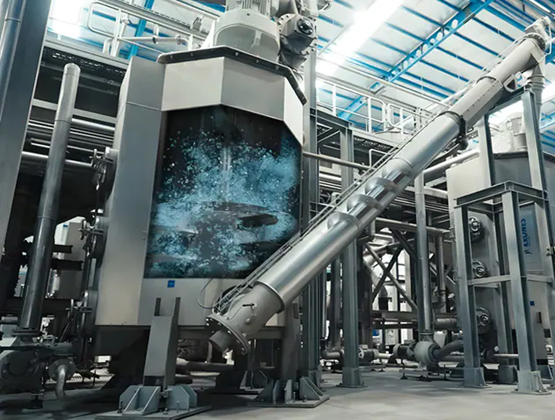
The process involves several stages, orchestrated by Krones teams with continuity in mind. The flakes first pass through a water pre-wash, which removes coarse residues such as labels and beverage remnants. Next comes the key density separation stage, or “sink-float tank”. PET, with a density of around 1.38 g/cm³, sinks in the water bath, while the lighter polyolefins found in caps and labels float to the surface and are skimmed off. This gravity-based separation determines the final purity of the product.
The next stage takes place in the patented intensive washer, a central element of Krones technology. The flakes are treated with a hot solution of water at 85°C and caustic soda, which removes residual adhesives, oils, greases and organic contaminants. The washer’s vertical design generates static pressure that causes the flakes to rub against each other, producing gentle mechanical cleaning. The slow rotation of the units and the washer’s thermal insulation are designed to minimise both the production of fine particles and energy losses.
A second high-temperature washing stage and a final rinse then remove the last polyolefin fractions from the labels. The flakes finally pass through mechanical drying by high-speed spinning, followed by thermal drying using hot air. A zigzag sifter removes remaining dust and label fragments. The result is clear or pale-blue flakes, calibrated between two and twelve millimetres, ready for final optical and laser sorting.
The Filao case, an industrial showcase in Belgium
Commissioned in January 2023 in Charleroi, the Filao plant is Belgium’s first facility dedicated exclusively to PET bottle recycling. A joint venture between Sources ALMA, one of Europe’s leading mineral water producers, and Veolia, a recycling expert, the site processes 40,000 tonnes of bottles each year, representing around 70% of those collected through Belgium’s blue bag system.
The line’s equipment was entrusted to Krones Recycling, which supplied most of the machinery and coordinated the integration of external components outside its own portfolio. The MetaPure W-PET module forms the heart of the process. According to data shared by Filao, production reached full capacity as early as August 2023, operating in three shifts, seven days a week, excluding annual maintenance. The line demonstrated a rapid industrial ramp-up, two months after the first trials, a clear indicator of the module’s maturity for operators working with tight deployment deadlines.
The site also illustrates a closed-loop circularity model at the scale of an industrial group. The flakes produced at Filao are then transported to Sources ALMA’s bottling plants in Europe, where they are transformed into pellets and then into new bottles. Within this scope, the operator states that each tonne of rPET produced generates three tonnes less CO₂ emissions than one tonne of virgin PET, a ratio that has become central to purchasing decisions among major beverage brands.
Structuring water and energy efficiency
One of the differentiating arguments of MetaPure W-PET lies in its integrated water cascade. Fresh water is introduced only at the end of the line, in the post-washer, then circulates backwards from the density separator to the pre-washer and grinder, where the flakes are most contaminated. This system enables Filao to achieve consumption of around 1.5 litres of water per kilogram of rPET produced, with a stated trajectory for further reduction and a medium-term closed-loop objective.
On the energy side, the thermal insulation of the intensive washer and the direct recovery of heat within the process help limit costs. At the Belgian site, 12,000 m² of photovoltaic panels cover around 20% of the plant’s electricity needs, illustrating the possible complementarity between process equipment and on-site energy generation in next-generation recycling facilities.
From washing to decontamination, a continuum towards food-grade quality
To achieve food-contact quality, MetaPure W-PET works alongside the MetaPure S decontamination module, which provides solid-state polycondensation (SSP) and increases the intrinsic viscosity (IV) of PET, a key property for blow-moulding suitability. The Krones portfolio is FDA and EFSA certified to produce food-grade PET that can be used with up to 100% rPET in packaging, in line with the requirements set by Regulation (EU) 2022/1616 on recycled plastic materials intended to come into contact with food.
This technological continuity responds to a specific market need. The European PET sector must now redirect part of its volumes, historically destined for textiles, towards bottle-to-bottle recycling and other food packaging applications, under the combined effect of SUPD and PPWR targets. Recyclers equipped with high-performance washing modules, capable of producing flakes that are clean, well calibrated and suitable for thermal decontamination, are therefore strategically positioned to capture this demand.
A key topic at ALLFORPACK EMBALLAGE PARIS 2026
The new edition of ALLFORPACK EMBALLAGE PARIS, scheduled from 24 to 26 November 2026 at Paris Nord Villepinte, structures its offering around four sectors, including “Process and packaging”, as well as a new area called “Re-generation”, dedicated to reusable, recyclable or compostable solutions. Rigid plastics recycling technologies, and particularly PET washing and decontamination modules, are expected to be among the key topics. Present among the exhibitors for the 2026 edition, Krones is directly part of this dynamic with the evolution of its MetaPure modules, whose Performance and Compact configurations presented in 2025 illustrate the transformations the show aims to highlight: circularity, industrial performance and adaptation to new regulatory requirements.
Image credit:
Yunus Tuğ - Unsplash