
FOOD PAPER AND BOARD PACKAGING: THE POST-PFAS TRANSITION REMAINS A WORK IN PROGRESS

These issues will be at the heart of ALLFORPACK EMBALLAGE PARIS, from 29 June to 1 July 2027.
Pizza boxes, chip bags, baking paper, takeaway food trays: some paper and board food packaging has long relied on fluorinated substances for resistance to grease and moisture. Since 12 August 2026, these substances have been subject to very low thresholds set by the European packaging regulation. The rule itself fits into just a few lines. On production lines, however, it opens up a technical, documentary and economic challenge that remains far from resolved for paper manufacturers, converters, printers and brands.
Food packaging: what the PPWR has required since 12 August 2026
Article 5(5) of Regulation (EU) 2025/40, known as the PPWR and applicable since 12 August 2026, applies to packaging intended to come into contact with food. It sets a first threshold of 25 ppb for any PFAS measured through targeted analysis, excluding polymeric PFAS, and a second threshold of 250 ppb for the sum of PFAS. A third threshold of 50 ppm applies to total PFAS content, including polymers. Above these values, packaging can no longer be placed on the EU market.
The European Commission’s frequently asked questions, published in its second edition on 3 August 2026 by the Directorate-General for Environment, clarifies the scope of the text. The limits apply to the packaging as a whole, including associated inks, varnishes, glues and adhesives. They apply both to intentionally added PFAS and to those present unintentionally. No list of PFAS with CAS numbers will be published: the thresholds apply to all substances that meet the definition set out in the regulation. The Commission also notes that packaging placed on the market before 12 August 2026 may remain there.
Packaging: why paper and board relied on PFAS
According to the European Food Safety Authority (EFSA), PFAS form a broad family of synthetic substances used to provide resistance to water, grease and stains, particularly in food packaging. Paper and board, by contrast, offer limited protection by nature. CITEO notes that this hydrophilic material readily absorbs water, which limits its use to dry products or requires it to be combined with other materials. The organisation also highlights its naturally weak barrier properties against water, air and grease.
The restriction responds to a broader health and environmental issue. In 2020, EFSA set a tolerable weekly intake of 4.4 nanograms per kilogram of body weight for four PFAS and notes that part of the European population exceeds this level. The agency states that migration from packaging contributes little to human exposure compared with other sources. The PPWR therefore also aims to address the persistence of these “forever chemicals” in the environment, rather than focusing solely on exposure through food.
PFAS: alternatives, but just as many trade-offs
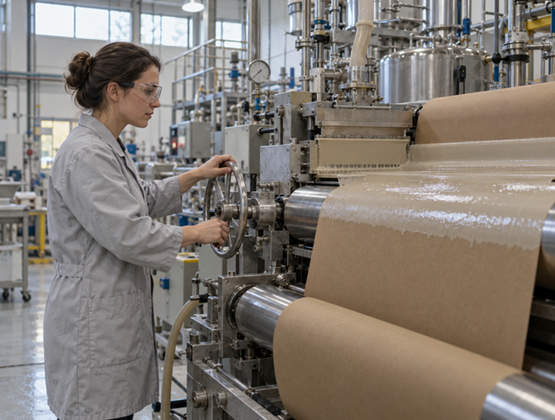
Several technical approaches are available. The Centre Technique du Papier (CTP) is working on three key technologies. The first is the water-based coating of barrier products (emulsions, dispersions, biopolymers). The second is chromatogeny, which makes paper and board hydrophobic and water-repellent. The third is the wet lamination of cellulose microfibrils (MFC), which provides a barrier against grease, oxygen and contaminants.
Chromatogeny illustrates both the progress made and its limitations. According to CITEO, it gives paper and board a water barrier and, when combined with PVOH, a grease barrier. The material retains more than 96% cellulose fibres, and the solution has been validated for food contact in trays, cups and flexible packaging. However, the grease barrier still relies on an additional component. Overall performance therefore depends on combining solutions rather than simply replacing one substance with another.
Research confirms that substitution comes at a cost. The European ZeroF project, coordinated by the Finnish research centre VTT and bringing together 12 partners from nine countries, has experienced this first-hand. Achieving both strong water and grease resistance at a reasonable cost proved to be a critical challenge. The project aimed to keep the increase in costs for consumers below 20%. Its leaders also point to the lack of safety data on PFAS alternatives, which complicated their assessment. For manufacturers, each choice of a PFAS-free barrier therefore has to be made on a case-by-case basis, matching barrier performance to the actual needs of the packaged product.
Recyclability: tomorrow’s barrier under scrutiny
An effective barrier must also meet recycling requirements. The PPWR requires all packaging to be recyclable in an economically viable way by 2030. The delegated acts setting the criteria for design for recycling must be adopted by 1 January 2028 at the latest. The European Commission warns that an integrated non-recyclable component can lower the recyclability rating of a packaging unit, or even make the entire packaging non-compliant.

Within the industry, the 4evergreen alliance published the third version of its Circularity by Design guideline in October 2024, with recommendations tailored to each component of fibre-based packaging. An entire section is devoted to barrier coatings and treatments. For paper and board food packaging, the chosen barrier is therefore assessed twice: first in terms of food safety, and then according to its behaviour in a recycling plant.
How can compliance be demonstrated without a harmonised method?
Demonstrating compliance remains a sensitive issue. The European Commission acknowledges that there is not yet a harmonised methodology at EU level for measuring PFAS in food contact packaging. A common testing protocol is being prepared with industry, civil society and Member State authorities, in coordination with the EU reference laboratory for food contact materials. Analysis of total fluorine serves as a starting point, and the Commission expects more laboratories to invest in these testing capabilities.
Compliance also depends on the supply chain. Manufacturers need information from material suppliers and converters to identify PFAS and prepare the declaration of conformity. According to the Commission’s FAQ, suppliers cannot refuse to provide this documentation, but final legal responsibility remains with the manufacturer. Inks, varnishes and adhesives also fall within this scope, placing printers and consumables suppliers under the same documentation requirements as paper manufacturers.
REACH, the next regulatory step
The PPWR is not the only legislation in development. According to the European Chemicals Agency (ECHA), the proposal for a universal PFAS restriction under REACH was submitted in January 2023 by the Netherlands, Germany, Denmark, Sweden and Norway. It covers all PFAS and their uses, including food contact materials and packaging. The Risk Assessment Committee (RAC) adopted its opinion on 2 March 2026. The Committee for Socio-Economic Analysis (SEAC) adopted a draft opinion on 10 March, which was open for consultation until 25 May, with its final opinion expected by the end of 2026. The RAC considers that current regulatory measures are not sufficient to control emissions.
The PPWR itself also provides for a review. Regulation (EU) 2025/40 requires the Commission to assess, by 12 August 2030 at the latest, whether the PFAS provision should be amended or repealed to avoid overlap with rules on food contact materials, REACH and persistent organic pollutants. The August 2026 thresholds therefore mark one stage in the process. The choice of alternative barriers made today should take into account a regulatory framework that may become even stricter.
See you at ALLFORPACK EMBALLAGE PARIS in June 2027
From 29 June to 1 July 2027, ALLFORPACK EMBALLAGE PARIS will bring the industry together at Paris Expo Porte de Versailles, Hall 1. The show is organised around four sectors, including Packaging & Materials and Design & Printing. These two sectors bring together the professions directly concerned by PFAS substitution, from barrier materials and coatings to inks, varnishes and adhesives.
Compliance with the PPWR and the fight against forever chemicals in packaging are among the key issues that will be at the heart of discussions at ALLFORPACK EMBALLAGE PARIS. The ALLFORPACK INNOVATIONS AWARDS extend this discussion by allowing professionals to explore new and innovative packaging solutions that address these challenges. Paper manufacturers, coating formulators and converters, brought together within the Packaging & Materials sector, will meet printers and food industry buyers to compare test results, production-line constraints and recyclability requirements. It is at this collective level that the post-PFAS transition for paper and board can move forward.