
PROFESSIONAL PACKAGING EPR: TOWARDS 1 JANUARY 2027

The obligations remain unchanged, and ALLFORPACK EMBALLAGE PARIS takes a look at the new timetable and the steps that companies placing products on the market can take now.
Professional packaging EPR: implementation delayed by six months
The timetable for professional packaging EPR has had a turbulent summer. The scheme was due to come into force on 1 July 2026. Shortly before the deadline, the Government announced that its implementation would be postponed, without setting a new date. On 28 July 2026, Mathieu Lefèvre, Minister Delegate for Ecological Transition, ended the uncertainty in a press release confirming that the scheme would become operational on 1 January 2027.
The ministry gave two reasons for the delay. The first concerns the identification of liable producers. Work at European level to determine which economic operators will be required to contribute has not yet been completed, and many companies were still unsure whether they needed to join one of the three approved producer responsibility organisations. The second reason concerns the fee schedules. Published late, they did not give companies enough time to incorporate this new cost into their business models. The minister has therefore asked the producer responsibility organisations to publish their 2027 fee schedules from September and announced that the administration will clarify all remaining uncertainties concerning obligations by September 2026 at the latest. The press release also sets the final deadline, stating that “every operator concerned must have joined a producer responsibility organisation by the end of the year”.
PROFESSIONAL PACKAGING EPR: what the postponement does not change
The legal framework remains fully in place. Decree No. 2025-1081 of 17 November 2025 establishes the scheme, while two orders dated 2 December 2025 set out the specifications for producer responsibility organisations and define how packaging is divided between the household and professional packaging schemes, as explained on the Ministry for Ecological Transition’s professional packaging page. These texts were introduced to bring France into line with the European Packaging and Packaging Waste Regulation, the PPWR.
The approvals also remain valid. Three producer responsibility organisations were approved in early June 2026 to implement the scheme: Citeo Pro, Léko Pro and Twiice. Three individual systems were also approved: Euro Pool System, International Pallet Pool and La Palette Rouge, according to ADEME’s information page on the scheme. The postponement does not affect these approvals, so companies can already compare the services, tools and support offered by these organisations.
The scope covering foodservice packaging also remains in force. The EPR scheme for foodservice packaging, which has been in place since March 2024, will continue to apply until it is incorporated into the professional packaging scheme on 1 January 2027. In its analysis of the postponement, Citeo Pro explains that producers of foodservice packaging will then need to enter into a new agreement with a producer responsibility organisation, and that eco-contributions will apply to packaging placed on the French market from 1 January 2027.
Who is considered a producer under the new scheme?
The PPWR introduced a new definition of producer, which has been incorporated into the French framework and detailed by the Ministry for Ecological Transition. For sales packaging and grouped packaging, the producer is the manufacturer, importer or distributor of the packaged product, meaning the packer in most cases, as under the household packaging EPR scheme. For transport, service and primary production packaging, the producer is the manufacturer, importer or distributor of the packaging itself. Two developments deserve particular attention. Private-label brands are now considered manufacturers and therefore producers. In addition, a micro-enterprise that has its products or packaging manufactured by a supplier established in France benefits from an exemption, with responsibility instead falling to the supplier.
The main difficulty concerns transport packaging made up of several components that only perform their function once assembled. The European Commission’s guidance document, in the version published in June 2026, identifies the assembler rather than the manufacturer of each individual component as the potential producer. According to the ministry, this interpretation raises implementation questions and is still under discussion between the Commission and Member States. This uncertainty, combined with the late publication of the fee schedules, was the main reason for the postponement, with a commitment to clarify the situation by the end of September 2026.
This timetable overlaps with that of the European regulation. Regulation (EU) 2025/40 has applied since 12 August 2026 and replaces the 1994 directive on packaging and packaging waste, as noted by ADEME. Companies importing or exporting packaged products must therefore align their French obligations with this harmonised European framework.
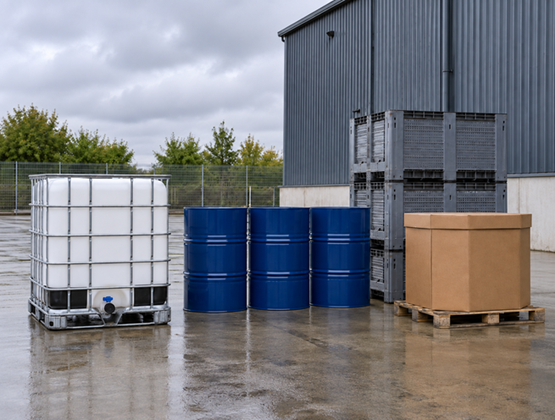
Approximately 12.5 million tonnes of packaging are placed on the market in France each year, including 7 million tonnes by professionals across all sectors, according to the Ministry for Ecological Transition. Of these 7 million tonnes, just over one million tonnes are plastic packaging, only a quarter of which is recycled. The scheme was designed to help close this gap, and its specifications set out quantified targets.
In terms of reduction, producer responsibility organisations must help reduce professional packaging waste by at least 5% by 2030 compared with 2010. For reuse, the ADEME information sheet details the 2030 targets, expressed in packaging units. 40% of transport packaging and sales packaging used for transport will have to be reusable and part of a reuse system, with a target of 100% for transport between sites belonging to the same operator or partner companies and for deliveries between economic operators within France, and 10% for grouped packaging in the form of boxes, with several exceptions provided for. For recycling, the rates expected from 2030 are 80% for steel, 60% for aluminium, 85% for paper and cardboard, 55% for plastic, 75% for glass and 30% for wood. These targets are reflected in eco-contributions. The specifications require fee adjustments that encourage reuse and the incorporation of recycled plastic, and producer responsibility organisations must propose additional measures, according to the ministry.
PROFESSIONAL PACKAGING EPR: what can be done now
The additional time is not a pause. It gives companies the opportunity to approach 1 January 2027 with reliable data and a producer responsibility organisation selected on an informed basis. Four areas of work can be addressed without waiting for the final clarifications.
The first is to classify your packaging. The scope order of 2 December 2025 automatically places pallets and palletisation components, large bulk containers such as big bags and IBCs, drums, cans, jerry cans and buckets over 29 litres, plastic crates and trays over 15 litres, octabins, as well as transport packaging and grouped packaging, within the professional packaging scheme, with exceptions for e-commerce intended for private consumers and for multipacks that can be split in-store. The ADEME classification guide details these rules and the weight or volume thresholds applicable to other packaged products. The same company may fall under both the household and professional packaging schemes for different product references.
The second area is inventory. Industrial and commercial packaging covers all materials, primary, secondary and tertiary formats, both single-use and reusable packaging, and imported products but not exports, as Twiice explains in its FAQ. Containers dedicated to processing and internal handling within a site are not included. Citeo Pro offers a free toolkit, Cap Emballages Pro, to help identify and record professional packaging ahead of future declarations. Companies already subject to reuse obligations under the AGEC law, namely those placing at least 10,000 units of packaged products on the market each year, already have a useful basis as they track their packaging using the accounting method described in the ADEME declaration guide.
The third area concerns the choice of producer responsibility organisation. The three approved organisations will publish their 2027 fee schedules in September 2026, and ADEME recommends joining one before 31 December 2026. Léko Pro highlights a single point of contact covering household packaging, paper and professional packaging. Twiice presents itself as a producer responsibility organisation entirely dedicated to professional packaging and has been running recycling pilot projects with industrial companies since 2019. Citeo Pro draws on its experience with the foodservice packaging scheme and has already opened its membership process, with free tools available during the first few months. Comparing these offers as soon as the fee schedules are published will help avoid making a rushed decision at the end of the year.
The fourth area is ecodesign. The fee adjustments provided for in the specifications reward reuse and the incorporation of recycled plastic. Work started now will make it possible to approach the first declarations with packaging that is already eligible for incentives. For further information, the replay of the webinar on professional packaging EPR, organised by ALLFORPACK EMBALLAGE PARIS with Citeo Pro, IPL Schoeller and the Fédération Nationale du Bois, as well as webinar #12 dedicated to the PPWR, are still available.
PROFESSIONAL PACKAGING EPR: key dates
September 2026 is the month announced for the publication of the 2027 fee schedules by Citeo Pro, Léko Pro and Twiice, as well as for clarification by the authorities of producers’ obligations. 31 December 2026 is the deadline recommended by ADEME for joining a producer responsibility organisation. 1 January 2027 marks the operational launch of the scheme and the integration of foodservice packaging into its scope. From 29 June to 1 July 2027, ALLFORPACK EMBALLAGE PARIS will bring the industry together at Paris Expo Porte de Versailles.
ALLFORPACK EMBALLAGE PARIS, six months after the scheme launches
The 2027 edition of ALLFORPACK EMBALLAGE PARIS will take place from 29 June to 1 July 2027 at Paris Expo Porte de Versailles, six months after the scheme comes into force. Between the publication of the fee schedules in September 2026 and the opening of the show, companies have nine months to turn this regulatory obligation into a business project.