
PACKAGING REUSE: TIME TO SCALE UP

Packaging reuse has moved beyond the pilot-project stage. Pallets, drums, plastic crates and returnable bottles have been circulating in professional channels for decades, while large-scale retail has been testing a shared reuse loop covering 16 million consumers since June 2025. The trajectory set by lawmakers remains some way off, however, and several operators are struggling to achieve economic viability. Here is an overview of a market that is entering a new phase, less than a year before the 2027 edition of ALLFORPACK EMBALLAGE PARIS.
1.82% of packaging reused in 2024, still far from the AGEC trajectory
The annual report by the National Observatory for Reuse and Reutilisation, overseen by ADEME, recorded 2.75 billion units of reused packaging placed on the French market in 2024 across all categories, representing a reuse rate of 1.82%. For household packaging alone, the rate falls to 1.59%, with 2.17 billion units declared, according to the 2024 report on household packaging and graphic paper.
The AGEC law set a target of 5% reused packaging in 2023 and aims for 10% in 2027, measured in sales units. Decree No. 2022-507 of 8 April 2022 sets out this trajectory according to turnover thresholds. In 2026, the requirement is 5% for producers with turnover below €20 million, 7% for those between €20 million and €50 million, and 8% above that level, before rising to 10% for all producers in 2027, as outlined on the Observatory’s packaging reuse page. Since 2024, any company placing at least 10,000 units of packaged products on the market must declare its reuse rate, while producer responsibility organisations must allocate at least 5% of collected contributions to financing reuse.
Reuse already industrialised in professional channels
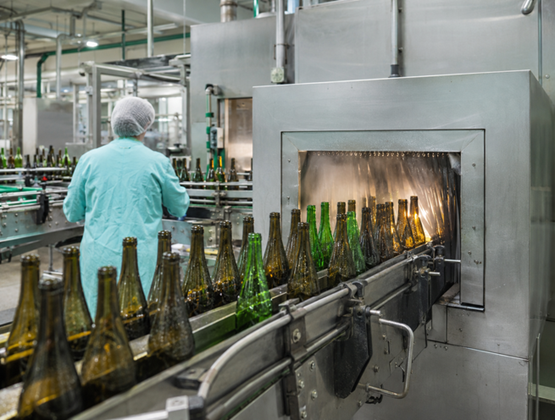
The second economic barometer of the bulk and packaging reuse sector, produced by Deloitte for Réseau Vrac et Réemploi with the support of Citeo and published in May 2026, includes professional packaging for the first time. Its strategic summary records more than 1.2 billion units of industrial and commercial packaging reused each year, with an average return rate of 96% and up to 120 rotations over 15 years for plastic crates. Pallets (300 to 350 million in circulation) and IBCs (900,000 collected in 2024, 87% of which were reused) form the backbone of this model, built on standardised formats, consolidated flows and stable B2B contracts.
Cafés, hotels and restaurants circulate more than 850 million returnable glass bottles each year through 600 wholesaler warehouses, according to the Fédération Nationale des Boissons cited in the barometer, alongside 17 million stainless steel kegs with a 30-year lifespan. In collective catering, 217 central kitchens report reuse to Citeo Pro, with 5.4 million reuse cycles of stainless steel gastronorm containers completed between March and December 2024 and a return rate of 99%. The return on investment is estimated at 7 years for a central kitchen that brings washing operations in-house.
Household packaging: real but fragile growth
For the consumer market, 24.2 million units of household packaging, excluding on-the-go consumption, were washed and placed back on the market in 2024, with more than 1,000 active in-store collection points and 45% growth expected by the end of 2026 among packaging suppliers, according to the 2026 barometer. Return rates vary significantly by channel, from 30% in supermarkets and hypermarkets to 45% in organic stores, 92% in specialist drive-through collection services and 95% for returnable home delivery, a channel that collected more than 15 million packages in 2024 (+50% year on year). The rejection rate after washing fell to 4%, compared with 15% in 2023. On-the-go consumption represents a separate segment, with 110 million cups and 8 million reusable meal containers washed in 2024, a 97% return rate at festivals but only 57% in conventional foodservice, and an initial cost 5 to 15 times higher than single-use packaging.
The sector generated €1.144 billion in revenue in 2024 for reuse operators and producers, supported 9,000 full-time equivalent jobs, and expects 20% additional recruitment by 2026, according to the same study. France had 64 operational washing centres in 2024, with 19 new sites announced by 2030. Yet these facilities remain underused. Capacity dedicated to household packaging is operating at around one third, and an additional 85 million packages could be processed each year without major investment.
This underuse has both an industrial and human cost. Washing operator Uzaje, founded in 2019 and operating four sites in Neuilly-sur-Marne, Avignon, Strasbourg and Lyon Saint-Priest, announced on 11 May 2026, following a hearing at the Bobigny Commercial Court and in the absence of a takeover offer, that it would cease operations effective 26 May, after washing more than 20 million containers. In its statement, the company referred to “a market whose development remained slower than expected” and uncertainty surrounding the implementation timetable for regulatory targets. Volumes, rather than infrastructure, are the missing link.
ReUse, the shared loop paving the way for national rollout
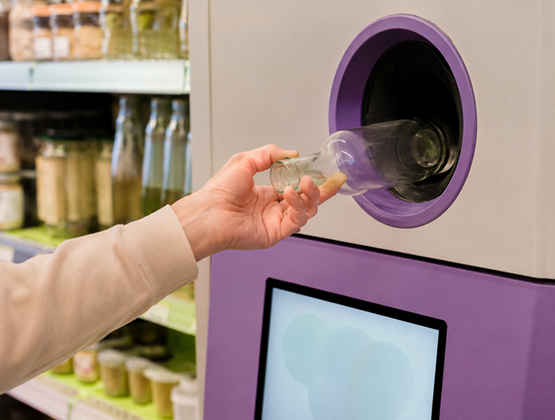
On 12 June 2025, Citeo launched ReUse across four regions (Brittany, Normandy, Pays de la Loire and Hauts-de-France), covering a population of 16 million consumers. More than 360 stores from six retail chains offer reusable packaging, with around 50 participating brands and nearly 170 product references. After twelve months, Citeo recorded 518,000 deposit-return products sold, representing 80% of the products placed on shelves, while the shopping experience received a score of 8.6 out of 10. The return rate remains the main weak point, with 108,000 packages returned, or 24% on average and up to 60% for certain products. The deposit, refunded to consumers via automated or semi-manual systems, ranges from 10 cents for smaller formats to 20 cents for larger ones. The standard R-Cœur range, shared across manufacturers, includes seven references, including the narrow-neck bottle, jars and wine bottles added in 2026, ahead of a planned national rollout by 2027. The lessons from this first year are detailed in the article dedicated to the ReUse trial.
The loop is operated by GO! RÉEMPLOI, the single service provider selected by Citeo for two years, from February 2025 to February 2027, following a call for expressions of interest. Chaired by Fabrice Peltier, a designer and expert in eco-designed and reusable packaging, the consortium brings together Fabrice Peltier Création, Massilly Conserver, Bocoloco, Bout' à Bout' and Haut la Consigne. It manages the packaging pool, organises collection, sorting, washing and return logistics, and operates the information system used to track each container. Two washing centres keep the loop running: Bout' à Bout' near Carquefou and Haut la Consigne near Lille. Since 2026, GO! RÉEMPLOI has also coordinated the reuse loop for more than 320 Biocoop stores.
PPWR and professional packaging EPR shift regulation towards mandatory requirements
Regulation (EU) 2025/40, known as the PPWR and applicable since 12 August 2026, sets reuse targets by packaging category. Transport packaging must be 40% reusable by 2030, grouped packaging 10%, and beverage distributors must offer 10% of products in reusable packaging, with exemptions for micro-enterprises and certain sectors. The regulation also sets indicative targets for 2040 of 70%, 25% and 40% respectively. Its first concrete requirements for the sector were explained in the article dedicated to the implementation of the PPWR and during a webinar on the key deadlines to anticipate.
In France, the professional packaging EPR scheme, created by Decree No. 2025-1081 of 17 November 2025, will come into force on 1 January 2027 following a postponement announced by the Ministry for Ecological Transition, as detailed in ADEME's information sheet on the scheme. Three producer responsibility organisations were approved on 5 June 2026 (Citeo Pro, Leko Pro and Twiice), along with three individual systems (Euro Pool System France, La Palette Rouge and International Pallet Pool), and producers must join one before 31 December 2026. The scheme's specifications incorporate the European targets, including 40% reusable transport packaging by 2030, 100% for flows between sites belonging to the same operator or between operators within France, and 10% for grouped packaging in the form of boxes. Eco-modulation already rewards reusability, with a 5% bonus on the eco-contribution for new reusable packaging in the foodservice sector.
Reuse: what are the barriers and levers for scaling up?
The 2026 barometer identifies obstacles common to all channels, starting with high initial investment across the entire chain (durable packaging, washing lines, collection, sorting, traceability and adaptation of packaging lines), fragile business models during the scale-up phase, and a maturity gap compared with single-use systems whose infrastructure has already been amortised. Other challenges include insufficient return rates in large-scale retail, the absence of a mandatory take-back requirement for distributors, limited deterrent effect from sanctions, and the diversity of formats. In e-commerce, reusable packaging remains two to four times more expensive than single-use packaging, with return rates ranging from 10% to 45% depending on the system, and up to 98% for click & collect.
Four common levers stand out, beginning with the consolidation of volumes, the main factor in reducing cost per cycle. This is followed by the considered standardisation of formats (R-Cœur, RVR packaging, stainless steel GN containers and standardised industrial and commercial packaging), the pooling of washing infrastructure and consolidation hubs, which reduces empty transport, and appropriate traceability, using barcodes or QR codes for household packaging and RFID for high-value professional flows. Funding is following this shift towards industrialisation. ADEME has mobilised more than €46 million since 2019, Citeo a cumulative €175 million between 2023 and 2025, while Citeo and Adelphe committed more than €68 million in 2024 to 228 projects, according to the same document. From an environmental perspective, ADEME's assessment published in 2023 found that a returnable glass package becomes more environmentally advantageous than a single-use glass package from its fourth use.
Consumers and the ALLFORPACK EMBALLAGE PARIS community are looking for "reusable packaging"
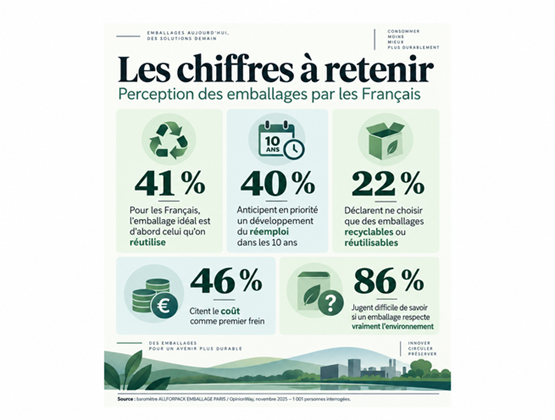
According to the November 2025 ALLFORPACK EMBALLAGE PARIS/OpinionWay barometer, conducted among 1,001 people, 41% of French consumers say the ideal packaging is, first and foremost, packaging that can be reused, while 40% expect reuse to be the main area of development over the next 10 years. One in five French consumers (22%) say they only choose recyclable or reusable packaging, but 46% cite cost as the main barrier and 86% find it difficult to know whether packaging is genuinely environmentally friendly.
Among the 200 companies surveyed by the show in October 2025 for the same study, legislation has become the main driver of environmental choices (55% of respondents), ahead of companies’ environmental impact and consumer expectations. The rise of plastic reusable packaging solutions ranks second among expected trends (38%), while 35% of professionals report growing consumer demand for reuse. Material prices remain the number one obstacle, cited by 65% of respondents.
See you at Paris Expo Porte de Versailles from 29 June to 1 July 2027
The 2027 edition of ALLFORPACK EMBALLAGE PARIS will take place from 29 June to 1 July 2027 at Paris Expo Porte de Versailles, at a time when the national rollout of deposit-return for reuse is expected and the professional packaging EPR scheme will be in its first year. The new Re-Génération exhibition area will bring together solutions for reducing resource use, circularity and reuse, traceability and responsible logistics, through innovations that can be applied at industrial scale. The ALLFORPACK INNOVATIONS AWARDS 2027 will recognise the most innovative solutions in packaging, processing and intralogistics.
Chantal de Lamotte, Show Director, has announced more machinery demonstrations and qualified business meetings for this Paris edition. For packaging managers, buyers or logistics professionals looking to build or join a reuse loop by 2030, the Packaging & Materials trail and activity areas will offer three days to compare standardised formats, washing and de-packaging equipment, traceability solutions and feedback from companies already operating reuse loops.