
ARANCO: PALLET WRAPPING IN THE AGE OF PPWR

A business model reshaping end-of-line operations
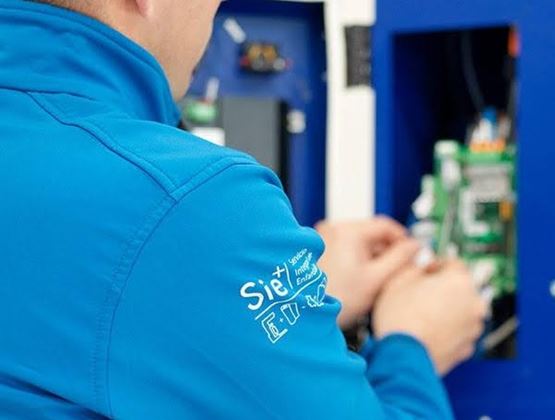
For a long time, pallet wrapping was seen as the final stage in a logistics chain: a consumables cost, never an optimisation lever. Aranco, a Spanish family-owned company founded in Valencia, has been taking the opposite approach for more than three decades. Its model, which it calls Integrated Packaging Service (Sie), is based on a simple principle that is still uncommon in the sector: pallet wrappers are made available to the customer with no investment, no installation costs and no maintenance costs. The customer only pays for the stretch film actually consumed.
This functionality-based economic model, applied to industrial packaging, changes the very nature of the dialogue between supplier and user. Where the traditional sale of machines mechanically encourages maximum consumables consumption, Aranco has every interest in reducing the amount of film used per pallet, since its profitability depends on the technical performance of the machine-film combination. According to data published in its sustainability report, the company reports an average reduction of 67% in film consumption and 85% in cardboard core consumption among equipped customers.
Transport packaging at the heart of new European obligations
Aranco’s industrial timetable directly intersects with European regulation. Regulation (EU) 2025/40, known as the PPWR, published in the Official Journal of the European Union on 22 January 2025, becomes fully applicable in all Member States on 12 August 2026, just a few weeks before ALLFORPACK EMBALLAGE PARIS. The text does more than set new recyclability or reuse targets. It redefines the very vocabulary of the sector: what was previously known as “tertiary packaging” officially becomes “transport packaging”, a category that explicitly includes pallets, transport cartons, logistics crates and stretch films used to stabilise loads, as noted in a recent analysis by ALLFORPACK EMBALLAGE PARIS.
This clarification is far from cosmetic. By 2030, the PPWR sets a target of 40% reusable B2B transport packaging, rising to 70% by 2040. Stretch films and pallet straps have a specific status: the first delegated act of the regulation, adopted in early 2026, specifically exempts them from 100% reuse obligations due to their technical constraints. This exemption is commented on by Réseau Vrac & Réemploi, which nevertheless points out that films still count towards the calculation of the overall reuse target. In other words, the pressure on the quantity and composition of film does not disappear; it shifts.
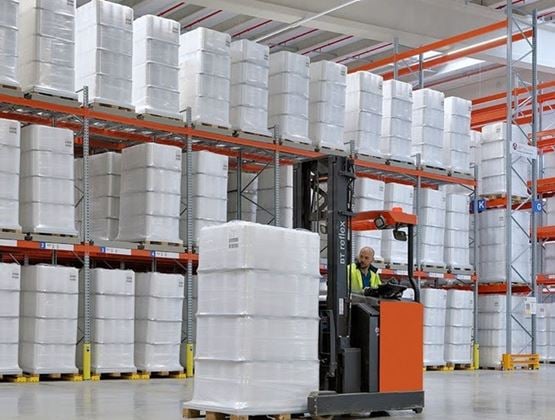
Low-micron films, PCR, RFID: materials in all their forms
The Valencian company manufactures its own stretch films at its Massamagrell plant, opened in 2021. Its range focuses on very low-micron films, between 6 and 11 microns for the high-performance automatic family, designed to offer mechanical strength equivalent to that of conventional films two to three times thicker. According to internal calculations verified in its non-financial reporting, each kilo of “optimised” film avoids around 1.6 to 2.1 kg of CO₂ emissions. Over the past twenty years, the company estimates that it has removed more than 60,000 tonnes of unproductive film from the market, equivalent to 106,000 tonnes of avoided emissions.
The EcoFilm range, developed with European partners, incorporates 30%, 40% and then 51% raw materials from post-consumer recycling (PCR). All films are also announced as 100% recyclable, positioning them favourably in relation to the recyclability-by-design requirements set out by the PPWR from 2030.
The other material innovation, less visible but structurally important, concerns traceability. Aranco equips its film reels with RFID tags, making it possible to link each wrapped pallet to a precise consumption in linear metres and to a real cost per pallet. This data feeds into an online platform, the Web Client, and forms the basis of an offer to digitalise existing pallet wrappers, the Control and Data Service (SCD), aimed at manufacturers that do not wish to replace their machine fleet but want to measure what they consume.
An autonomous stretch-wrapping machine recognised by DHL
Aronco’s expertise was recognised in April 2023 by the DHL Green & Digital Innovation Awards, in the Innovation category for supply chain robotisation. The award-winning machine, called AMR, combines a rotating-arm pallet wrapper and an autonomous electric pallet truck in a single piece of equipment. Designed and manufactured in Valencia, it moves independently through the warehouse, without permanent human supervision, and carries out transport, pallet wrapping and data generation operations. A laser device detects the presence of an operator or obstacle within the arm’s rotation radius and triggers an automatic stop, a key element in compliance with Machinery directives.
This type of robotisation explicitly targets two structural issues in end-of-line logistics: the strain of manual pallet wrapping, long identified by the European Agency for Safety and Health at Work as a factor in musculoskeletal disorders, and the variability of packaging quality depending on operators, which can lead to breakage during transport.
A sustainability trajectory documented according to GRI standards
Aranco presents itself as the first Spanish company in the packaging services sector to have published a sustainability report compliant with GRI (Global Reporting Initiative) standards, the most widely used international framework for non-financial reporting. This approach, initiated for the 2021 financial year and renewed every year since, is part of a 2022-2030 sustainability master plan whose main milestones align with the expectations of major European clients: decarbonisation, due diligence across the supply chain, and alignment with the United Nations Sustainable Development Goals (SDGs).
The company operates under a ZERO WASTE label, manufactures using 100% renewable energy, including self-consumption photovoltaic panels and certified renewable electricity, and has structured a dedicated sustainability consulting department, whose experts support customers in drafting their own declarations of conformity.
Positioning directly aligned with the ALLFORPACK EMBALLAGE PARIS 2026 sectors
Aranco’s offering sits at the intersection of several areas of ALLFORPACK EMBALLAGE PARIS 2026, reconfigured this year around four sectors: Packaging and materials, Design and printing, Process and packaging, and Intralogistics and transport. The Valencian manufacturer’s integrated service combines machines, for Process and packaging, consumables, for Packaging and materials, and digital tools designed for end-of-line logistics, for Intralogistics and transport, three areas that manufacturers have traditionally purchased from separate suppliers.
This cross-functional approach reflects the watchword chosen by the show for its 2026 edition, “Unbox your potential”, and finds a particular resonance in the new Re-generation area, dedicated to reusable, recyclable or compostable packaging solutions. For visitors responsible for packaging procurement, logistics and CSR functions, the event will offer an opportunity, over three days, to compare competing approaches to the same challenge: transforming a cost centre into a lever for industrial management.