
REUSE LOOP: ONE YEAR OF PILOTING ACROSS FOUR REGIONS

A major structural project for the entire packaging sector, at the heart of the discussions led by ALLFORPACK EMBALLAGE PARIS.
How does the reuse loop work?
Reuse involves using packaging several times for the same purpose, whereas recycling breaks down the material to produce something new. In practice, a reusable glass bottle is consumed, returned by the customer, washed industrially and then placed back on the shelf after being refilled with a new product. This organised cycle is known as a reuse loop.
To operate successfully on a large scale, this loop requires several conditions to be met at the same time: standardised packaging shared by several brands, reverse logistics capable of collecting and transporting containers, certified washing centres and a simple return process for consumers. This is precisely the infrastructure being tested by the ReUse initiative, launched by the producer responsibility organisation Citeo to lay the foundations for a nationwide, shared reuse system for food packaging sold through supermarkets and other large and medium-sized retailers. The environmental benefits are well documented: according to the ADEME press kit published in June 2023, life cycle analysis shows that reusable glass bottles consistently deliver environmental benefits after just two to four uses, based on indicators including climate change, acidification and fossil resource depletion.
The model is based on a shared logistics loop coordinated by a single service provider, Go! Réemploi, appointed for two years, from February 2025 to February 2027, following a call for expressions of interest launched by Citeo. Chaired by Fabrice Peltier, the consortium brings together several companies specialising in traceability, washing and logistics. Two washing centres operate the system: Bout’ à Bout’ near Carquefou and Haut la Consigne near Lille.
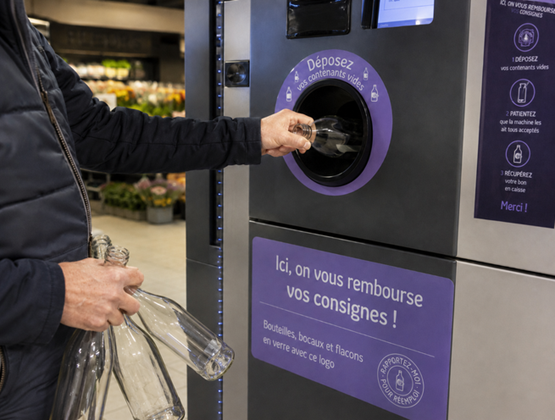
On 12 June 2025, Citeo launched ReUse across an area covering 16 million consumers in four regions: Brittany, Normandy, Pays de la Loire and Hauts-de-France. These regions were selected in particular for their existing momentum in reuse. The scheme brings together nearly 400 stakeholders, including manufacturers, retailers and operators, within a single shared loop. While large-scale retail accounts for around 85% of packaging consumption in France, less than 2% of this packaging is currently reused, according to Citeo data.
Twelve months later, the time has come for an initial assessment, and the results require a nuanced reading. According to figures released by Citeo, 663,000 reusable packages were placed on the market during the period and 518,000 products were sold, representing a sell-through rate of 80%. Most notably, monthly sales increased thirteenfold, rising from 5,000 units in June 2025 to 67,000 in May 2026. The network now includes 362 active stores, compared with just 28 at launch, alongside six retail partners, 52 participating brands and 169 product references available on shelves.
Results below initial ambitions
These results nevertheless fall short of the targets announced at launch. The 362 active stores remain well below the initial target of 750, partly because Biocoop withdrew from the scheme after encountering difficulties in managing the deposit system. “The system as it has been implemented works,” says Valentin Fournel, Director of Innovation, Eco-design and Reuse at Citeo, who nevertheless describes the shift as “irreversible”.
The most fragile indicator remains the return rate. Over the course of one year, 108,000 containers were returned through reverse-vending machines, representing an average return rate of around 24%. However, certain fast-moving products, such as water, milk and some organic juices, are already achieving rates of 60%. This gap confirms that the habit is taking hold first for everyday products purchased in larger volumes. It also suggests that a consumer who has purchased only one or two deposit-bearing bottles may be less inclined to return them in exchange for a deposit refund of just 10 to 20 cents per container.
What the initial findings reveal
The main lesson concerns how the scheme has been received by those who have tested it. Surveys conducted by Ipsos among 1,670 shoppers produced an average score of 8.6 out of 10 and a repurchase intention of 63%. Once consumers adopt the habit, satisfaction therefore appears to be high.
The main obstacle lies further upstream. Awareness remains limited, with only 21% of respondents saying they knew about the scheme before entering the store. The product offering also remains insufficient: limited product variety is the leading barrier to purchase for 33% of consumers, with an average of 17.5 references per store. In-store visibility also plays a decisive role, with a product clearly identified as reusable achieving a return rate of 48%, compared with 19% for a similar but less visible product.
On the industrial side, the system’s technical robustness has been confirmed: more than 470 collections have been completed, almost 50,000 packages have already been washed and returned to circulation, equipment availability stands at 95%, and the breakage rate has been halved in one year, falling from 2.6% to 1.3%.
A scheme supported by the European regulatory framework
This pilot responds to binding targets established at both French and European level. The AGEC Act (Anti-Waste for a Circular Economy Act), adopted in 2020, sets a target for reusable packaging to account for 10% of all packaging placed on the French market by 2027. At European Union level, Regulation (EU) 2025/40, known as the PPWR (Packaging and Packaging Waste Regulation), was published in the Official Journal of the European Union on 22 January 2025 and will become fully applicable from 12 August 2026. It establishes progressive reuse targets for 2030 and 2040.
This regulatory framework is one of the most important structural issues facing the sector. The changes in terminology and obligations introduced by the PPWR were examined in an overview of the new packaging categories, helping to explain how container standardisation, an essential condition for a shared reuse loop, fits into the new legal landscape. The relationship between AGEC and the PPWR was also explored during a webinar on circular strategies for the plastics sector, which reiterated a simple principle: reuse is only justified where environmental assessments confirm its benefits. Finally, the regulation’s practical deadlines, beginning with its application on 12 August 2026, were reviewed during a webinar dedicated to the obligations businesses need to anticipate, together with an operational roadmap for achieving compliance.
Building on these initial results, Citeo is preparing the next stage. The producer responsibility organisation is planning a new phase from 2026, with an expansion of the standardised packaging range R-Cœur, which includes seven formats in total, including new designs introduced in 2026 such as narrow-neck bottles, jars and wine bottles. The network is also expected to exceed 450 stores by the end of the year. The second half of 2026 will be devoted to consultations with all stakeholders to define the conditions for a nationwide rollout, including the business model, logistics structure, pooling arrangements and scale-up pathway. After one year of testing, the debate is no longer about the technical feasibility of reuse in large-scale retail, but about the conditions required to take it to scale.

These R-Cœur standards, designed to be shared by several manufacturers, already account for 70% of volumes sold. They embody ReUse’s central premise: without shared packaging, infrastructure and logistics, no reuse loop can achieve critical scale. This is also what sets the initiative apart from the many local reuse schemes already operating across France.
For packaging manufacturers, producers placing products on the market, logistics providers and retailers, these findings outline the types of solutions that will need to be designed, standardised and industrialised in the years ahead. This is the field explored by ALLFORPACK EMBALLAGE PARIS, the biennial meeting for the entire packaging value chain, whose next edition will take place from 29 June to 1 July 2027 at Paris Expo Porte de Versailles, just as the nationwide rollout of reuse enters a decisive phase. The show features a dedicated exhibition area, Re-Génération, focused on resource efficiency, circularity, reuse and traceability solutions, while the Paris Talks conference programme places return schemes, circularity and the European regulatory framework at the heart of the debate. These will offer valuable opportunities to compare your packaging strategy with lessons from a system moving from pilot stage to widespread adoption.