
PACKAGING REUSE: FROM PILOT PROJECTS TO SCALE-UP

Organised by ALLFORPACK EMBALLAGE PARIS on 24 November 2026, Webinar #13 brought together Clara Mottier, Senior Manager at Deloitte Sustainability France, Anne-Sophie Colin, Managing Director of GO! Réemploi, Romain Bernard, Head of the Flows Department at Groupement Mousquetaires, and Xavier Gauthier, head of Packaging Innovation at Agromousquetaires. Chantal de Lamotte, Show Director, set the scene in her introduction: today, the question is no longer whether reuse is possible, but under what conditions it can work on a large scale.
Packaging reuse: a starting point that shows the scale of the challenge
Anne-Sophie Colin opened the discussion with figures that put ambitions into perspective. In France, 140 billion household packaging units are placed on the market each year. Of this total, around 2 billion are currently reused, a rate of 1.56%. But nearly 90% of these 2 billion are checkout bags. Reusable bottles, jars and trays account for only 500 million units, almost exclusively in out-of-home food service. In mass retail, the volume falls to 30 million units, or 0.02% of the market.
Why such a difference with the hotel, restaurant and café channel? There, the loop was never abandoned: a drinks distributor delivers full containers, collects the empties and refunds the deposit to regular customers. In mass retail, consumers have to bring the packaging back, there are far more product references, and the whole logistics chain back to the washing centres has yet to be built. The challenge is less technical than organisational.
Packaging reuse: lessons from the ReUse experiment
GO! Réemploi operates the ReUse experiment, steered by Citeo. In eighteen months, several building blocks of an industrial system have been put in place at the same time: a network of around 400 active stores from all the major retail chains (Coopérative U, Carrefour, Auchan, Leclerc, Intermarché), a network of washing centres across the country, common deposit and food safety rules, and a clearing house to balance flows between producers and retailers. Interoperability is at the heart of the system: packaging bought in one chain can be returned to any other.
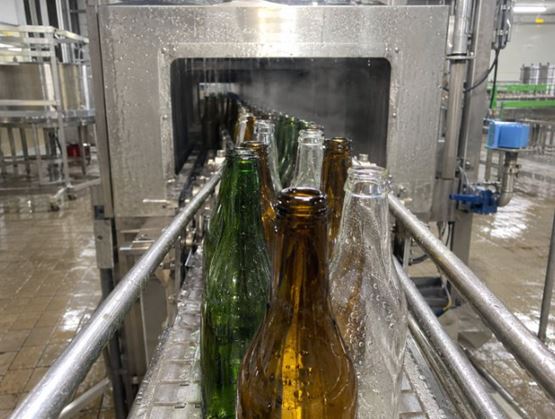
For the loop to last, three challenges remain. The first is increasing volumes: as long as delivery rounds are not full, logistics costs remain prohibitive. The second is the active involvement of stores, which must list reusable products themselves and organise the return of empty packaging, which is not yet part of their routines. The third is the range available on the shelves: consumers surveyed during in-store events want to find their everyday products there, not a token selection.
Carbon footprint and regulatory targets
The question of the environmental benefit of reuse was raised directly. Anne-Sophie Colin cited a study by ADEME updated in 2023: for glass, reuse saves 60 to 80% of CO2 compared with single use, from the second use onwards. The environmental advantage holds even over distances of up to 800 kilometres. The comparison with plastic containing a high share of recycled material gives more mixed results, but for products with strong potential for large volumes, such as beverages and groceries in glass, the balance remains positive.
On the regulatory side, the targets are set. The French AGEC law provides for 7% reuse in 2025 for producers with a turnover above 50 million euros, then 10% in 2027 for all. The European PPWR regulation sets a target of 10% in 2030 for beverages. The gap between these targets and the 0.02% observed in mass retail is considerable, and the time needed to build operational loops is measured in years.
To find out more about the regulatory framework for packaging, read our article on the future of plastic packaging.
Professional packaging: a faster field to clear
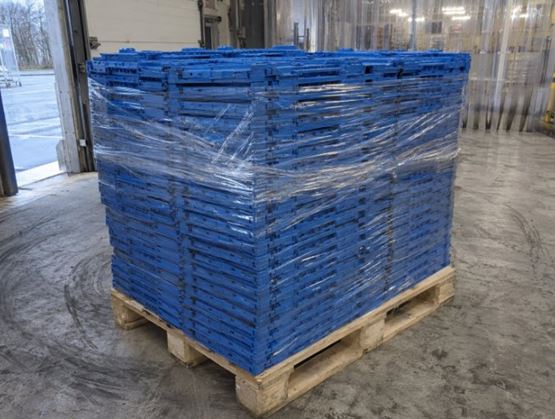
Romain Bernard presented the case of Groupement Mousquetaires, which has 20 fresh-produce hubs and 2,800 points of sale. Today, deliveries between the hubs and the stores generate several million single-use cases a year. A test was carried out with a cooked-meats supplier and a co-packer: the supplier delivers in a reusable crate, the store folds it after use, the hub collects it and sends it back to the washing centre, which returns it to the manufacturer. The circuit works. The difficulties are operational: clearly identifying the crates to avoid losses, making sure store teams set them aside, and ensuring quick collection so that stockrooms do not become cluttered.
Xavier Gauthier added the packing perspective. For secondary packaging, reusable plastic crates are hard to reconcile with automated lines designed for single-use cardboard cases: for some flows, this is not an adaptation but a complete replacement of the line. For primary packaging, switching to a reusable glass bottle on a line that currently runs plastic is a major investment. On the other hand, where glass is already used, the adjustments remain minor. This is why Xavier Gauthier believes that progress will be faster, and quicker to demonstrate internally, on professional packaging, where the consumer is not part of the loop.
Economics: the real tipping point
Price was the central topic of the second part of the webinar. Anne-Sophie Colin gave a concrete order of magnitude: today, the cost of a reuse loop to collect, sort, wash and put a bottle back into circulation is around 1 euro. Buying a single-use bottle costs around 20 cents. This 80-cent gap has to be financed until volumes bring costs down. GO! Réemploi’s break-even point is estimated at 200 million packaging units in the loops: beyond that threshold, a reused bottle could be sold to a producer for less than a single-use bottle.
Xavier Gauthier summed up the industrial logic: the performance of packing lines determines the cost price, which determines the shelf price, which determines volume. As long as the reusable price remains higher than single use, mass roll-out will not happen. Clara Mottier pointed out that standardising packaging does not mean making everything uniform: the shape of the cap, the colour and the label still leave room for brands to stand out. The article devoted to the interview with Clara Mottier before the webinar details these trade-offs.
Five conditions for scaling up
Clara Mottier concluded the discussion by drawing out five cross-cutting points. First, think about the whole loop rather than the packaging alone: collection, washing, quality control and return to circulation. Next, standardise to build volume: common formats make it possible to pool volumes and share logistics costs. The third condition is to build on existing flows and infrastructure rather than rebuilding everything. Fourth, pool volumes and resources to reduce costs at every stage of the loop. Finally, clarify roles and responsibilities: who invests, who handles which operations, and how costs are shared between retailers, producers and producer responsibility organisations.
To go further on packaging materials and circularity, read our feature on packaging and materials.
See you at ALLFORPACK EMBALLAGE PARIS 2027
Reuse will be one of the key topics of the Re-Génération area, the new ALLFORPACK EMBALLAGE PARIS space dedicated to the circular economy. The next edition takes place from Tuesday 29 June to Thursday 1 July 2027 at Paris Expo Porte de Versailles. Three days to meet the players building the loops of tomorrow.